Showing posts with label Brooklyn Botanic Garden. Show all posts

Tuesday, March 1, 2011

Chase Away the Winter Blues at the Brooklyn Botanic Garden

It’s been a long, rough winter, and the Brooklyn Botanic Garden (BBG) is offering a “Chase Away the Winter Blues” tour this coming Sunday, March 6 at 1 p.m. From BBG’s web site:

Science has developed some understanding of what causes the “winter blues” — and more important, what helps keep them at bay. Exposure to daylight, even on a cloudy day, can help restore energy, alertness, and contentment.

Over a dozen different kinds of flowers grace the grounds of BBG in late winter. Celebrate the transition from winter to spring by admiring petite, colorful and sturdy blooms that are undeterred by the frosts and snows of March.

Join licensed psychotherapist and veteran BBG tour guide Lynne Spevack, LCSW, for this hour-long, outdoor narrated walk designed to relieve the winter doldrums. Learn what you can do to maintain a sunny outlook through the dark, cold days of winter while discovering the plants and animals that enliven the garden landscape in the depths of winter. This walk is held rain, snow, or shine; dress warmly and wear comfortable walking shoes.

The tour is free with Garden admission, there is no reservation required. Meet in front of the Visitor Center.

BBG also offers free winter weekdays, which last until March 13. As always, admission on Saturdays from 10 a.m. to noon is free (except during special events). For more information visit www.bbg.org.

Friday, August 20, 2010

SIte-Specific Art Installation at Botanic Garden Made of Branches from Invasive Species

This morning, installation artist Patrick Dougherty (above center), who creates whimsical woven structures from saplings and twigs, completed the first site-specific sculpture to ever be commissioned by the Brooklyn Botanic Garden (BBG). 

Dougherty began construction of the large-scale sculpture on Aug. 5 in the Plant Family Collection meadow, and over the next three weeks enlisted the help of about 50 volunteers to build the piece. The finished work is comprised of several structures that resemble huts and are linked together from above by a network of arches.

“It’s a retreat for feral children and wayward adults,” Dougherty said.

Willow branches from the nonnative species salix atrocinerea — designated as an invasive species in New York State — make up the installation. This material was collected from Ocean Breeze Park on Staten Island. It’s supplemented by branches from BBG’s collection of cherry trees.

To build the structures, 30-inch holes were dug into the ground to anchor the foundational branches, and additional material was woven in from there. As the structure got larger, scaffolding was constructed around it so workers could weave up to more than 10 feet.

When thinking of the overall design, Dougherty wanted the piece to “fill the space in an adequate way,” and used a nearby tree whose branches hung above as a guide.

“You’re working as though you’re building a drawing,” he said. 

During the construction process, garden visitors could watch Dougherty and the volunteers build the sculpture. Toward the end of the process, he said, a four-year-old visiting with her mother saw it said, “It looks like natural history!” So Dougherty decided to name the piece, “Natural History.”

The sculpture will be on display in the garden for a year — commemorating the institution’s centennial — so visitors can see it throughout the seasons, said BBG spokesperson Kate Blumm.
“We want to take it down while it still looks good,” said Dougherty.
Dougherty has been constructing large-scale sculptures out of tree branches since the early 1980s, but started making a living at it around 1985, he said.

He’s done more than 200 installations around the world, and for him, the process of making art is as important as the end result. He is also publishing a book of photographs of past projects, called Stickwork.

As is evident by the fact that he involved so many volunteers in his craft, he feels that we all have “stickwork” within us. 

“Kids seem to know everything about sticks, so we all seem to know at one point,” he said.

For more information about the installation process, visit www.bbg.org. For more information about Patrick Dougherty’s work, visit stickwork.net.

Friday, August 6, 2010

Flatbush Block Claims Title of Brooklyn's Greenest Block


Every year, the Vanderveer Place Block Association enters its block — on Vanderveer Place between Flatbush Avenue and East 23rd Street in Flatbush — in the Brooklyn Botanic Garden’s (BBG) Greenest Block in Brooklyn Contest. And every year, the block comes in first, second or third.

“We are passionate about this contest,” said Olivia Avery, president of the block association. This year, Vanderveer Place took top honors in the residential category — the third time it’s done so in the contest’s 16-year history, Avery said with a smile.

The 2010 winners were announced at a press conference Wednesday at the winning block. BBG’s community environmental horticulture program, GreenBridge, holds the contest every year, with support by the Brooklyn Community Foundation.

“We had incredible participation across Brooklyn,” said BBG President Scot Medbury, who noted that 220 blocks from 20 neighborhoods participated in the contest. “It’s a reminder of the incredible growth of this borough. Brooklyn is famous for its ‘can do’ attitude and its one-of-a-kind style.”


Residents gathered among the flowers and greenery joined by Borough President Marty Markowitz, GreenBridge director Robin Simmen and Brooklyn Community Foundation President Marilyn Gelber, to recognize winners in all categories.

“Vanderveer Place has set a new standard,” Gelber said. “In a small way this block reflects everything about Brooklyn.”

Other winners were: Hoyt Street between State Street and Atlantic Avenue in Boerum Hill, which took top honors in the commercial category; Bainbridge Street between Malcolm X Boulevard and Stuyvesant Avenue in Bedford-Stuyvesant, which won for best street tree beds; Brooklyn’s Finest Garden, on Lefferts Place between St. James and Grand Avenue in Clinton Hill, which won best community garden streetscape; Sam Hall on State Street in Boerum Hill, which won for best window box; and Burrito Bar in Prospect Heights, which won greenest storefront. 


A panel of more than 30 judges look at a number of criteria including color and total visual effect, citizen participation, variety and suitability of plants, soil condition, use of mulch, street tree and tree bed care and other good horticultural practices. The panel, made up of professional horticulturalists from the garden and other greening organizations throughout the city, visited the blocks from mid-June through July.

“Today blocks like Vanderveer carry on Brooklyn’s green tradition,” said Markowitz. “When we plant seeds all of Brooklyn blooms.”


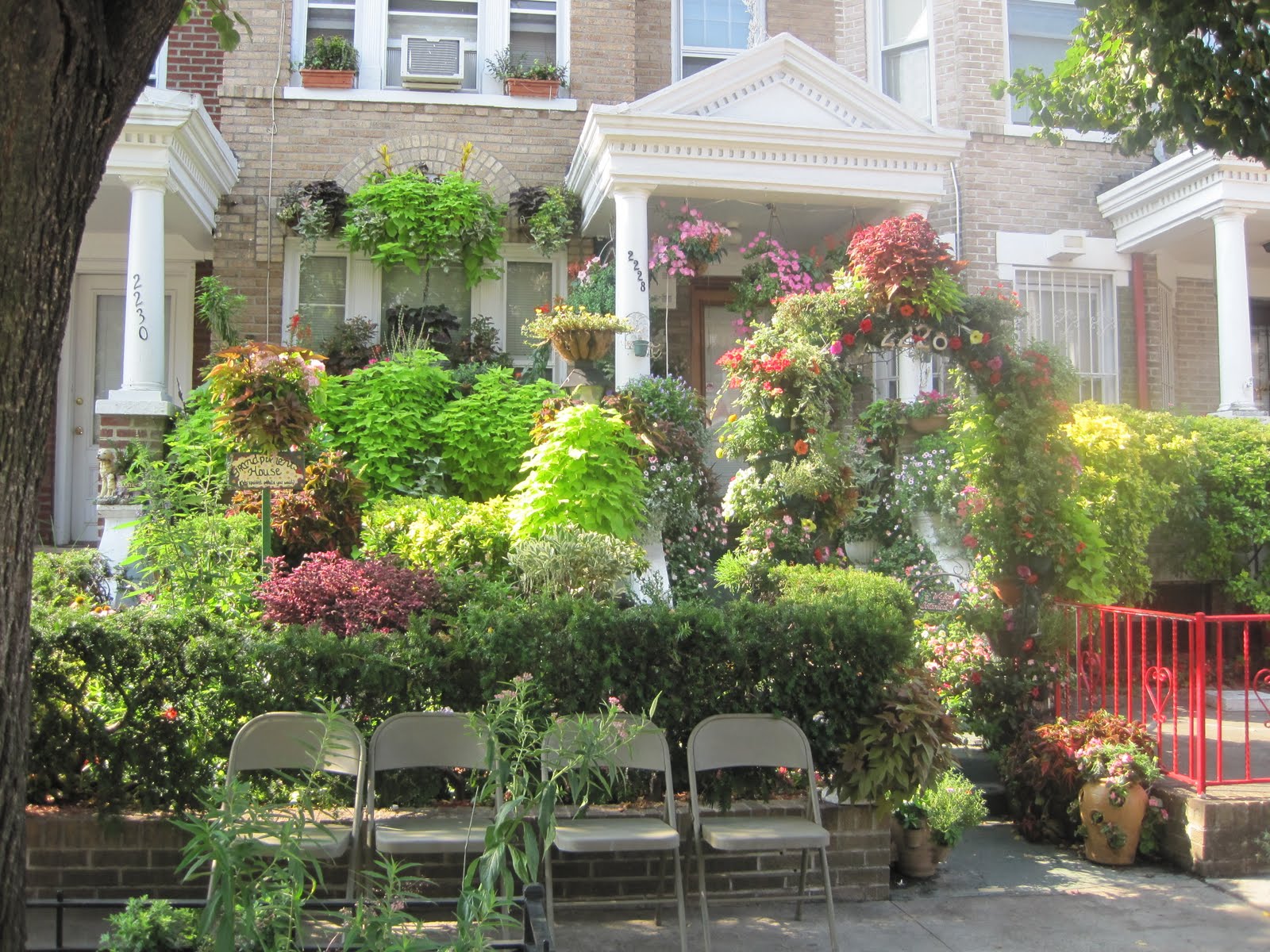
On a block where one person’s house rivals the next, Bob Johnson’s house (above, top photo) stands apart from the rest. An archway covered with flowers and vines acts as a gate, plants line the stoop, the yard is covered with greens, and window boxes populate each window.

Johnson, a resident of Vanderveer Place for 39 years, is very involved in the block association, and says a lot of people stop by his yard to take pictures of the arch. His garden has potato plants, petunias and “quite a few perennials.”

As one of the longest residents on the block, he says, “I call myself ‘the mayor.’ Everyone knows each other. It’s a very vibrant block association.”


Avery, who has been president of the association for four years, but a resident of the block for 35, agrees: “It’s just a nice little block.”

Her own garden has potato plants, petunias, snowdrops and Black Eyed Susans. “It makes the house and the block look beautiful and that’s something you strive for wherever you live,” she said. As for Brooklyn, she adds, “It’s the garden spot of the world.”

Friday, July 2, 2010

Native Plant Month at Brooklyn Botanic Garden

During the month of July, the Brooklyn Botanic Garden (BBG) will highlight the New York Metropolitan region’s native flora, displaying its beauty, explaining its importance, drawing attention to its plight, and providing simple ways to help in its restoration.

In 1911, the “Local Flora Section” was the first garden to open to the public at BBG. It’s now known as the Native Flora Garden. Following is a list of programs for Native Plant Month at the garden.

Curator's Tour: The Native Flora Garden with Uli Lorimer
Thursday, July 8, 5–6 p.m.
Curator Uli Lorimer will lead a tour of BBG’s 99-year-old Native Flora Garden, which represents nine local plant communities, including the distinctive kettle pond and pine barrens habitats. Get behind-the-scenes insight into this extraordinary garden and how it has evolved since 1911. Learn about the visionary work of BBG’s founders in researching and documenting native plant life, both in the Garden and the greater metropolitan area. Fee and registration required; call (718) 623-7220 or go to bbg.org/classregistration. Registration deadline is Wednesday, July 7, but there’s limited space, so register now.

Talk: Bringing Nature Home
Thursday, July 8, 6:30 p.m.
With as many as 33,000 species imperiled in the U.S. alone, it is clear that citizens must change their approach to gardening and landscaping if they hope to share space with other living things. Ecologist and author Doug Tallamy will talk about the key role native flora must play in the restoration of our landscapes. Only by supporting a large, healthy diversity of insects that coevolved with native plants can we keep herbivores in balance and gardens aesthetically pleasing. Advance registration is recommended but seats may be available at the door. Call (718) 623-7220 or go to bbg.org/classregistration. There will be a fee for this event.

Field Trip: Native Plants and Restored Natural Areas: A Field Trip to Staten Island
Saturday, July 10, 8:30 a.m.–2:30 p.m.
This day trip, led by restorationist Cindy Goulder, begins with a private guided tour of the Greenbelt Native Plant Center, the NYC Parks Department’s 13-acre nursery and greenhouses on Staten Island. See how hundreds of native plant species are propagated and grown from seed and learn principles underlying native plant cultivation. The Sweetbrook Stream and Wetland Restorations help recover the ecological health and function of urban waters, thanks to the indigenous wetland and upland plant species intentionally placed to increase local plant diversity and wildlife habitat. The Salt Marsh Restorations at Old Place Creek have reestablished many acres of tidal marshes after centuries of displacement by agricultural and industrial uses. Learn how invasive plants were removed and zones of marsh and maritime woody plants reintroduced to this estuarine community. Fee and registration required; call (718) 623-7220 or go to bbg.org/classregistration. Registration deadline is Wednesday, July 7.

Class: Great Natives for Tough Places
Sunday, July 11, 10 a.m.–12:30 p.m.
This workshop, led by garden designer Joan McDonald and based on the BBG handbook Great Natives for Tough Places, identifies gardening challenges caused by city buildings, impermeable surfaces, rainwater runoff, construction, and other disturbances that compact and degrade soil. Students will explore solutions with five spectacular designs using unusual native plants chosen for their ability to thrive in urban environments. Students will receive a copy of Great Natives for Tough Places. Fee and registration required; call (718) 623-7220 or go to bbg.org/classregistration. Registration deadline is Thursday, July 8.

Workshop: Gardening with Native Plants
Tuesday, July 13, 6–9 p.m.
Why are native plants important, and which ones are best for a garden? What does “native” really mean, anyway? Explore these questions with native plant authority Uli Lorimer, curator of BBG’s Native Flora Garden and learn how a garden can reflect the region’s — even a densely populated urban region’s — spectacular natural environment. Fee and registration required; call (718) 623-7220 or go to bbg.org/classregistration. Registration deadline is Monday, July 12.

Class: Edible Native Plants in Brooklyn
Saturday, July 18, 2–5 p.m.
Wild ginger, spicebush, fiddlehead ferns, wild leeks—these are just a few of the delicious vegetables and seasonings native to the region. Unlike conventional crops, many of the northeastern edible native plants are excellent for shade gardens, and most are perennials that will feed people year after year. Learn from local food specialist Leda Meredith (and Park Slope resident) which edible native plants will thrive in a garden and how to grow, harvest, and use them. Fee and registration required; call (718) 623-7220 or go to bbg.org/classregistration. Registration deadline is Thursday, July 15, there’s limited space, so register now.

Visit www.bbg.org for more information about Native Plant Month

Thursday, May 20, 2010

Greenest Block in Brooklyn Deadline is June 1

The Greenest Block in Brooklyn contest is back for its 16th year, and the deadline for entries is Monday, June 1. The Brooklyn Botanic Garden's Greenbridge program holds the contest every year in cooperation with Borough President Marty Markowitz and with sponsorship by Brooklyn Community Foundation.

Brooklyn block, civic, homeowoner and other community organizations can enter to win the Greenest Residential Block, Greenest Commercial Block, Greenest Storefront, Best Window Box, Best Street Tree Beds, Best Community Garden Streetscape and Best Greenbridge Window-Box Kit titles. There are three rounds of judging during which blocks are evaluated on criteria including color and total visual effect, citizen participation, variety and suitability of plants, soil condition, use of mulch, street tree and tree bed care and other horticultural practices.


The Greenest Block in Brooklyn promotes screetscape gardening, tree stewardship and community development in the borough. Participation in the contest has increased from 50 blocks in the first year to more than 250 last year.

Last year's Residential First Place winner was Lincoln Road between Rogers and Bedford Avenues in Lefferts Gardens (pictured here). This year's winner will be announced in August.

Photos by Phoebe Neidl 

Back to homepage

Tuesday, May 4, 2010

Brooklyn Botanic Garden Plant Extravaganza!

In 1945, the Women’s Auxiliary of the Brooklyn Botanic Garden started the Daffodil Bridge Party, selling several varieties of plants to bring people to the garden and make some money at the same time. The plant sale grew even as bridge parties went out of style, moving to Magnolia Plaza, the Lily Pool Terrace and to Cherry Esplanade, where it is today.
Now, the Plant Sale at the Brooklyn Botanic Garden (BBG) is in its 57th year and has grown to be the largest of its kind in the Northeast, with over 20,000 plants available. Held Wednesday, May 5, from 9 a.m. to 8 p.m. and Thursday, May 6, from 9 a.m. to noon, it’s sponsored this year by Monrovia Nurseries.
Volunteers from the Brooklyn Botanic Garden Auxiliary — which began admitting men around 1975 — along with garden employees, sell the plants and offer gardening advice to plant purchasers.
Friends and fellow Brooklynites Lois Carswell (who lives in Park Slope) and Lucille Plotz (who resides in Brooklyn Heights) have chaired the sale together for over 35 years.
“People come from all over: Westchester, Long Island, Connecticut,” said Carswell. Some bring vans to take home their loot, she noted. “It’s an extravaganza!”
“We have every kind of plant you can imagine — orchids, calla lilies, ferns, begonias, petunias,” said Plotz, who is so devoted to the sale that she went to school to get a botany degree. “Anything you can think of, we’ve got.”
Many people come to the plant sale to buy plants that they’ve seen and admired in the garden before, said Plotz, like climbing roses, which are very popular, or tree peonies, which are exclusive — “you don’t see those everywhere.”
The plant sale Wednesday will feature special events as well. BBG bonsai curator Julian Velasco will lead a bonsai clinic and demonstration. For a fee, he will prune and repot any pest-free bonsai and offer advice. Sessions are from 10 a.m. to noon and 2 to 3 p.m.
David Horak, the curator of BBG’s orchid collection will discuss repotting and reblooming orchids at noon and 3 p.m., and at 10 a.m. and 3 p.m., learn how to use culinary herbs for sale.
Experts will be on hand throughout both days to offer advice, said Carswell. “We try to make gardeners out of people.”
For more information, visit www.bbg.org.

Back to homepage

Wednesday, April 14, 2010

Scenes of Spring at the Brooklyn Botanic Garden

I had a chance to stop by the Brooklyn Botanic Garden this morning, where Hanami, or the Cherry Blossom viewing season, is in full force. Flowers and plants are blooming all over the garden. It's open Tuesday through Friday from 8 a.m. to 6 p.m., Saturday and Sunday, 10 a.m. to 6 p.m. Free guided tours are offered on Saturdays and Sundays at 1 p.m.


Tuesday, April 6, 2010

National Grid Provides Grant to Garden's Project Green Reach

Brooklyn Botanic Garden (BBG) received a $250,000 grant from National Grid for Project Green Reach, which provides hands-on lessons in science and botany for Brooklyn’s Title I schools, many with large numbers of children from low-income families. Project Green Reach annually serves 2,500 students in grades K through 8 and 80 teachers. The grant is part of National Grid’s “Engineering Our Future” initiative to inspire and encourage youth to study science, technology, engineering and math. Shown here, left to right are: Brooklyn Borough President Marty Markowitz, National Grid Chief Executive Steve Holliday, BBG Chairman Emeritus Earl Weiner, and BBG Vice President of Development Leslie Findlen.
Photo courtesy National Grid

Back to homepage

Tuesday, February 2, 2010

Cold Weather Getting You Down? Head to the Brooklyn Botanic Garden

Chase away the winter blues at the Brooklyn Botanic Garden (BBG). According to the its web site, exposure to daylight, even on a cloudy day, can help restore energy, alertness, and contentment. BBG has a wealth of ongoing programming, from classes to public tours.
Choose from an extensive list of adult classes this winter: register for one in Tai Chi Cuan, or one in designing a brownstone garden. GreenBridge, the community environmental horticulture program at BBG, offers free workshops (space is limited) in topics such as starting seeds indoors or street tree care.
Coming up this Sunday, Feb. 7, there will be a special theme tour to rid you of the winter blues: an hour-long wintertime walk conducted by Lynne Spevack, LCSW, a licensed psychotherapist and veteran BBG tour guide . Two tours remain this season, one this Sunday, Feb. 7, and one on Sunday, March 7, beginning at 1 p.m. Meet at the Visitor Center, dress warmly and wear comfortable shoes. Rain or shine.
Or, you can visit the garden on your own. Admission is free on weekdays from now until March 2.

Photo courtesy of BBG.

Monday, October 26, 2009

Botanic Garden Trees Named State Champions

The New York State Department of Environmental Conservation has named two trees at the Brooklyn Botanic Garden state champions — meaning they are the largest of their species on record in the state. The Kansas hawthorn and the Carolina holly are the first trees in New York City to receive this honor. The awards will be presented at a ceremony tomorrow in the shade of the champion trees.
 

Back to homepage

Tuesday, September 1, 2009

Brooklyn Botanic Garden Photo Contest

The Brooklyn Botanic Garden (BBG) is calling all photographers (amateur and otherwise) for its seasonal photo contest and asking visitors to focus on themselves. Dubbed "Me @ BBG!" the contest will document the diverse community of people who visit the garden. Photos are submitted by posting them on the Me @ BBG! Flickr group, and one will be chosen as the photo of the week for the next three weeks. Winners will receive a $20 gift certificate to the garden shops. For more information, to post photos and to view past week's winners, visit www.bbg.org.

Back to homepage

Thursday, July 9, 2009

Botanic Garden Unveils Plans For 'Green' Visitor Center


The Brooklyn Botanic Garden (BBG) last week released plans for its new Visitor Center pavilion, which is slated to replace the current entrance adjacent to the northern parking lot at 900 Washington Ave. The project will break ground this summer and is planned to open in spring 2011.

As the first new structure built at the garden in 20 years and designed by architecture firm Weiss/Manfredi — architects of the Seattle Art Museum’s celebrated Olympic Sculpture Park — the 22,000-square-foot complex will house a new garden shop, an orientation room for tours and classes, an information desk, an event space, a refreshment bar and restrooms.

Visitors will cross a welcoming plaza, accented with plantings, to enter the new building. From the entrance, the center will extend westward toward the Cherry Esplanade.

Conceived as a seamless extension of the Garden’s landscape, the sinuous glass building, nestled into an existing berm at the Garden’s northeast corner, will serve as a three-dimensional continuation of the garden path system, framing a series of views into and through the Garden.

“Some of the world’s best buildings take their cues from natural settings,” said BBG President Scot Medbury. “Our vision for the new Visitor Center is that it should be an extension of the landscape, not just serving as a physical entry to the Garden but creating opportunities to enrich the visitor experience so that even before they begin their Garden tour, they will be transported.”

While the form and materials of the new building will echo historic structures at the Garden, its design and function will belong to the 21st century as the Garden’s first green structure, certified by the U.S. Green Building Council’s Leadership in Energy and Environmental Design (LEED) Green Building Rating System. The Visitor Center will apply to receive a LEED Gold certification.

Sustainable design elements featured in the new center will include recycled building materials, passive solar components, geothermal heating, and bioswales (recessed catchment zones filled with water-loving plants) that will improve storm-water management and relieve the burden on the municipal sewer system.

The design will also feature a “living roof” that will utilize a wide range of native and/or drought-resistant plants, offering both energy savings and seasonal displays.

“We are in awe of both the exceptional beauty and the environmental sustainability of this innovative design,” said Medbury. “The new Visitor Center will physically embody our institutional commitment to conservation. We hope it will also inspire our neighbors and visitors to think about how they can incorporate green solutions into their own homes, businesses and lives.”

Weiss/Manfredi’s design was presented with a prestigious Award for Excellence in Design by the Public Design Commission of the City of New York. The award recognizes the superb integration of form, function, and sustainable practice in the design of the Garden’s new Visitor Center.

“A botanic garden is an unusual kind of museum with a living collection that is constantly changing,” said Marion Weiss, principal at Weiss/Manfredi. “The new Visitor Center is conceived as inhabitable topography, defining the threshold between the city and the Garden. Like the Garden itself, the building is experienced cinematically and is never seen in its entirety.”

“To provoke curiosity and interest in the world-class collection, the new building will provide a legible point of arrival and orientation, an interface between culture and cultivation,” said Michael Manfredi, also a principal at the firm.

“A chameleon-like structure, the Visitor Center transitions from an architectural presence at the street into a structured landscape within the Garden. The building redefines the physical and philosophical relationship between visitor and garden, introducing new connections between landscape and structure, exhibition and movement.”

The Visitor Center’s design was approved by the Design Commission in June 2008. Lead funding for the Visitor Center has been provided by Mayor Michael Bloomberg, the New York City Council, Brooklyn Borough President Marty Markowitz and Representative Yvette C. Clarke.

Rendering courtesy of Weiss/Manfredi

Back to homepage

Wednesday, April 29, 2009

From Green to Pink: Cherry Blossoms Return to BBG


This weekend, tens of thousands of visitors will flock to the Brooklyn Botanic Garden (BBG) to experience what has become one of springtime’s most anticipated events: Sakura Matsuri, the annual Cherry Blossom Festival.

While this year is the 28th annual celebration, the cherry blossom trees have been around much longer. “Some of the original planting started in 1912, and the cherry walk was actually planted in 1921,” said Mark Fisher, BBG director of horticulture.

Today, the assortment of
trees in the garden is the largest and most diverse outside Japan. The festival, which will take place this Saturday and Sunday, May 2 and 3, will not only celebrate the trees, but also Japanese culture.

“We continue to add more projects and demonstrations and performers each year,” Fisher told the Eagle. “It reaches both the contemporary and the traditional Japanese culture.”

Among the attractions this weekend will include music from Japanese pop star Ai Kawashima; the Sakura J-Lounge, with a lineup of DJs spinning Japanese pop and rock; taiko (an ancient art of drumming) performances; traditional and contemporary Japanese dance; martial arts group Samurai Sword Soul; and the New York premiere of the film, Transcending — The Wat Misaka Story, a documentary about the first Japanese-American basketball player in the NBA.

Special this year is a collaboration between the garden and the N.Y. Anime Festival. Anime-lovers in costume will participate in the city’s largest cos-play (costume roleplay) photo shoot and visitors will be able to read and examine the Japanese comics, also called manga. Illustrator Misako Rocks! will also discuss inspiration for her manga and also lead a special children’s session.

“I’m very proud of [Sakura Matsuri]. I’m very excited because what it highlights for us — what people enjoy — are the plants. That’s really what we’re celebrating,” Fisher said. “Cherry blossoms symbolically represent the ephemeralness of life and how fast it fleets.

“I think we all start viewing it that way as we look at the cherries and enjoy the beauty — it only lasts just a couple of weeks,” he continued. “That’s it until next year, so it becomes special for all of us.”

For additional information and a full schedule of Festival events, visit bbg.org/sakuramatsuri.

Back to homepage

Tuesday, April 28, 2009

Remember the Tree that Moved?


Remember when the Brooklyn Botanic Garden moved a 200 ton Ginkgo Biloba tree to make way for its new visitor center, to be located at at the entrance to the garden off the parking lot to the Brooklyn Museum?

If you didn't know there used to be a tree near the herb garden, you wouldn't be able to tell. The ground is level, and if you look in the distance, you can see the tree, at home in its new location!

Check out the story here.

Back to homepage

Tuesday, March 10, 2009

Botanic Garden ‘Grows’ Kids With Green Values


On Saturday, as temperatures rose to unseasonably high levels and the sun came out, the Brooklyn Botanic Garden (BBG) held its 28th annual Making Brooklyn Bloom event.

Adults and children alike came out in droves to the garden for this year’s theme, “Growing Up Green: Guiding Youth From Gardening to Green-Collar Jobs.”

The theme was designed to engage kids in gardening and thus to mobilize the “greening” of urban communities, which wil
l hopefully then lead more people to green-collar careers. Scot Medbury, BBG president, said that one of the reasons the garden chose this theme was because of the “popular support for a new green-collar economy by President Obama.”

Participants attended morning and afternoon workshops, on topics ranging from cooking to gardening to composting, and perused exhibits in the Palm House (right).

The exhibits were given by greening groups from not only Brooklyn but New York City as a whole. Among the exhibitors were the Center for the Urban Environment, the Brooklyn Compost Project, East New York Farms and Slow Food NYC.

GreenBridge, the garden’s community horticulture program, gave out free plants at the Urban Oasis exhibit. At Solar One’s exhibit, attendants made solar-powered cars and at the Wyckoff Farmhouse Museum exhibit, children helped make apple cider.

Green-Collar Job Panel
One of the workshops was a panel discussing emerging green-collar jobs. Panelists were Kate Zidar (below, far right) of the North Brooklyn Compost Project, Omar Freilla (below center) of the Green Worker Cooperative in the Bronx, Ian Marvy (below, second from left) of Added Value, Annette Williams (below, second from right) of Sustainable South Bronx and Brian Aucoin (below, far left) of MillionTreesNYC Training Program.

Discussion was generated through questions from the audience, many of which were geared toward the current economic climate.

One prominent topic was how to generate revenue for a green start-up. Aucoin said, “You get it where y
ou can, any way possible,” and stressed the importance of fundraising. Freilla spoke about the New York Regional Association of Grantmakers (NYRAG), but Marvy told the audience, “it’s going to be tough for you to get a grant this year.”

He continued by saying that if you’re interested in starting a green initiative, “look at what community investment means.” He explained that he might look to his neighbors and ask them to forgo a cup of coffee a day, instead putting that money toward the initiative.

Zidar added that because of the “economic doom and gloom ,the local model starts to make more and more sense.” She gave the example of waste oil from restaurants. These restaurants could pay to have it removed, or a local business could take that oil and convert it into biodiesel fuel.

The consensus among the panelists was that it might be difficult because of the economy, but there are still many opportunities to start a green-collar career. “Grab on to a vision,” Marvy said. “It’s about leadership and finding people to work on your vision.”


Speaker Addresses Importance of Youth

The keynote speaker at the garden’s event was Maurice Small (below), program coordinator of City Fresh, an organization dedicated to building a sustainable food system in Northeast Ohio by making locally grown food more available. Small enlists underprivileged youth to help him build community gardens.

“To have entrepreneurs, you have to have confidence,” he said. “I like to think these young people are like plants. The better you nurture them the better they’ll grow. I’m confident that these young people can change countries.”

Youth in Small’s programs learn how to make compost and grow food, which they then sell. He said there was nothing more exciting to him than seeing a young person eating food that they themselves have grown.

“There is an incredible renaissance going on here,” said GreenBridge director Robin Simmen. She explained that despite recent budget cuts, the organization has figured out how to extend the Brooklyn Compost Project — “Maybe the New York City’s greenest project ever” — to 2010.

“The public is more eager than ever to learn about sustainability,” she said.

Top photo is of Elan and Ana Rabiner making apple cider at the Wyckoff Farmhouse Museum's exhibit.

Back to homepage