 The Family Justice Center at the Brooklyn D.A.’s Office just got a little greener.
Brooklyn-born author Suzanne Corso visited the center yesterday to donate 10 copies of her new book, Sammy and Sue Go Green Too. District Attorney Charles Hynes (pictured with Corso) was on hand to receive the donation.
Hynes called Corso a “wonderful, aggressive entrepreneur, who is generous and kind to donate 10 books to our Family Justice Center.” He added, “I can speak as an expert because I have 16 grandchildren.
Born and raised in Bensonhurst, Sammy and Sue Go Green Too, is a collaboration with Corso’s 10-year-old daughter, to whom she has taught eco-friendly habits.
Since she instilled green values — such as shutting off the lights, eating organically and using eco-friendly paints — in her daughter, Corso figured, “If I could teach her, I could teach anybody.” So she started her company, Sammy and Sue Enterprises, which is a company geared toward educating children about all things green.
Sammy and Sue Go Green Too is the first in a series of children’s books Corso will release about environmental awareness. While she donated the books to the Family Justice Center this week, the official release of her book will be on Earth Day, April 22.
Corso wants to urge parents to “teach your child one thing a week, one thing a month,” about being eco-friendly. “We have to hit this generation,” she said.
The Family Justice Center, opened by D.A. Hynes in 2005, is a support center for domestic-violence victims and their children, offering a variety of services, including legal support.
Last month, thousands of books were donated to the center to create the Brooke Jackman Library and Literacy Center, in memory of the 23-year-old college graduate who perished in the September 11 terrorist attacks.
Visit www.sammyandsuellc.com for more information on Corso’s books and company.
The Eagle received this press release:
Congresswoman Nydia M. Velázquez sat down with local businesses and community leaders on Tuesday to discuss ways for New York City to lead the nation in developing sustainable manufacturing and green jobs. She also toured a number of environmentally-friendly businesses in the Brooklyn Navy Yard.
The Congresswoman’s district, which includes the Navy Yard, contains some of the most significant clusters of green manufacturers in the United States.
“The efforts being spearheaded in Brooklyn show small businesses across the country the benefits of developing and using new technologies,” Velázquez said. “These entrepreneurs are opening new businesses to manufacture green products, and have drastically cut their overhead costs by increasing energy efficiency. This is a business model for the nation to follow.”
At Tuesday’s Green Manufacturers Business Roundtable, co-hosted by the Brooklyn Navy Yard Development Corporation and the New York Industrial Retention Network (NYIRN), Velázquez highlighted the assistance available for entrepreneurs to continue leading in the development of green products and technologies.
New York City is home to as many as 25,000 green collar jobs, but that number is projected to skyrocket in coming years. The Navy Yard, where 30 businesses currently employ 350 people, expects to triple its green manufacturing operations in the next three years.
“New York City’s economy will benefit from the green revolution. As other sectors scale back, these industries continue to grow and bring good-paying jobs to our communities,” Velázquez said.
As Chairwoman of the House Small Business Committee, Velázquez worked to ensure the Energy Independence and Security Act signed into law last year included initiatives that give entrepreneurs the tools to acquire efficient technologies and increase renewable production. This year, the Committee plans to reauthorize the Small Business Innovation Research (SBIR) program, which helps small firms get the capital needed to develop new, cutting-edge products.
The American Recovery and Reinvestment Act also helped business development by renewing green energy tax credits and making it easier for small businesses owners to obtain loans. With small firms making up 84 percent of New York’s manufacturers, these efforts will help as they shift focus to environmentally-friendly products and technologies.
“Small business owners face unprecedented challenges in today’s environment, but their ingenuity and determination is untouched. By supporting efforts to bring sustainable manufacturing and green jobs to our City, we can help small firms pull the nation out of this economic downturn,” Velázquez said.
 Mayor Bloomberg came to the Brooklyn Navy Yard (BNY) yesterday to open the new Perry Avenue Building, the nation’s first multi-story green industrial facility. The $25 million building, which began construction 18 months ago, is on track to receive LEED gold certification and features the first permanent building-mounted wind turbines to be operating anywhere in New York City.
The building “heralds the emergence of the Brooklyn Navy Yard, the city’s most successful industrial business, as the nation’s greenest industrial center as well,” said Mayor Bloomberg.
He also announced the creation of Duggal Greenhouse, a 60,000-square-foot LEED platinum certified facility that will be a “center for designing and manufacturing eco-friendly products.”
These projects, as well as other green initiatives, will create 800 new construction jobs and “more than 1,700 new permanent jobs over the next two years, many of them in green manufacturing and design,” the mayor said. Right now, there are 350 green jobs at the Navy Yard, but “within two years we project that there will be nearly three times that many.”
Mayor Bloomberg made his announcements on the roof of the building, in front of the new wind turbines. He was accompanied by Deputy Mayor for Economic Development Robert Lieber, BNY Development Corporation Chairman Alan Fishman, BNY Development Corporation President Andrew Kimball, Borough President Marty Markowitz, Council Member David Yassky and Assembly Member Joseph Lentol.
The turbines, combined with rooftop solar panels, will provide electricity for the building’s lobby and other common areas, which will amount to about 10 percent of the overall energy. The rest comes from a power plant in the Navy Yard, which uses natural gas.
Other green features of the Perry Avenue Building are reflective roofing and pavement to reduce surface temperatures, the use of recycled rain water in toilets, recycled building materials, high-efficiency lighting fixtures, natural ventilation systems and special accommodation for bicyclists and low-emission vehicles.
SurroundArt will lease the building, and will create a Museum Resource Campus to serve the art industry and institutions in New York City.
Five wind- and solar-powered street lights (below), created by Duggal Visual Solutions (who will create the Duggal Greenhouse), have been installed in the Navy Yard. Eventually, there will be 90 of these street lights in the facility. 
“Not only do the [wind- and solar-powered street lights] cost 35 percent less to install than their more conventional counterparts, they’ll also save the Brooklyn Navy Yard Development Corporation about $11,000 annually in the cost of electricity,” said Mayor Bloomberg.
Borough President Markowitz said of Baldev Duggal, the mastermind behind the wind-solar street lamps, “these are the kind of visionaries that this city is investing in. That’s why I know that our future is going to be superb. It has to be. New York, and especially Brooklyn, among the most environmentally active communities across the country, will lead the way.”
President and CEO of the Brooklyn Navy Yard Development Corporation, Andrew Kimball, said, “It’s easy to be green when you have a mayor who’s become an international/national leader on urban sustainable issues ... it’s easy to be green when you have local elected officials who are pushing us everyday to create those jobs, particularly green jobs.
“Most of all it’s easy to be green when you have tenants like SurroundArt and Duggal Visual Solutions and 30 other green manufacturers already doing business inside the Navy Yard,” Kimball continued. “People across America are talking about green jobs, they’re talking about the future. We have those jobs here today at the Brooklyn Navy Yard.”
The expansion of the Navy Yard and creation of green sector jobs is part of the city’s “Five Borough Economic Opportunity Plan.” This plan will “help New Yorkers find work today, create jobs in diverse sectors in the future, and make our neighborhoods more affordable and more green as we go,” said Deputy Director Lieber.
New York City is implementing a $250 million capital funding program to improve and modernize the Brooklyn Navy Yard’s infrastructure. The expansion will add over 1.5 million square feet of new space. Mayor Bloomberg announced last month that the city’s $35 million project to reconstruct several roadways in the Navy Yard area and upgrade water and sewer systems will benefit from nearly $5 million now available due to the Federal stimulus allocation to the city.
DUMBO NYC reports that the condos in the green building at 100 Gold St. in Vinegar Hill. The 5-story, 10-unit building is being marketed by Corcoran and is the first green building in Vinegar Hill.
Check out the prices and info here.
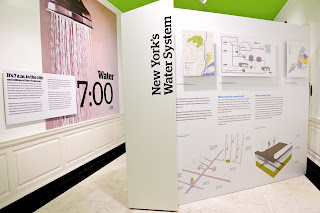 The Museum of the City of New York has an interesting exhibit showing now through Earth Day, April 22. It's called "Growing and Greening New York: PlaNYC and the Future of the City," and if you haven't seen it yet, you should check it out.
The exhibit takes you through a day in the life of a "typical" New Yorker, touching on six different features of the day: water, transportation, energy, open space, land and climate change.
You can sit in a "green" living room, examine a solar panel up close, see a model of the Bronx Zoo Lion House (the first LEED gold retrofitted New York City landmark), and much more.
 Everyone who visits the exhibit is guaranteed to learn something; useful facts and information abound. For example, did you know that a leaky faucet wastes 20 gallons of water a day?
It's so important in these times to learn as much as you can about the environment and what you can do make an impact. The museum geared the exhibition toward individuals, showing them that it's possible to reduce the effects of global warming one step at a time, said Deputy Director Sarah Henry.
Here is a list of upcoming programs associated with the exhibit:
- Big Apple Brownfield Awards, Monday, April 13, 10 a.m. The Partnership for Brownfield Practitioners celebrates New York City's most successful brownfield clean-up and redevelopment projects. Reservations required, $15 general admission, $10 museum members, seniors and students.
- PlaNYC: Innovations and Legacy, Wednesday, April 15, 6:30 p.m. A discussion of the relationship of PlaNYC to the history of urban planning. With Dan Doctroff, president of Bloomberg LP, former deputy mayor for Economic Development and the originator of PlaNYC; Hilary Ballon, university professor ans associate vice chancellor for NYU Abu Dhabi; and Thomas Bender, university professor of the humanities, NYU. Registration is required.
- From Fram to Table: New York City's Local Food Movement, Tuesday, April 21, 6:30 p.m. Panel discussion on being a "locavore" in the city. With Dan Barber, executive chef/co-owner of Blue Hill at Stone Barns and Blue Hill; Michael Hurwitz, director of Greenmarket; and Ian Marvy, director and co-founder with Michael Hurwitz of Added Value and its Red Hook Community Farm. Gabrielle Langholtz, editor of Edible Manhattan and Edible Brooklyn, will moderate. Reservations required.
To make reservations, order tickets online at www.mcny.org or by phone at (212) 534-1672 x 3395. Visit www.mcny.org for more information.
Photographs by C. Bay Milin
Though the 30-year-old Center for the Urban Environment (CUE) has been shut down for a week, information on why it closed has been scarce. With the exception of a press release sent out by the staff detailing their reaction, no one is saying much about the abrupt closure. Calls to executive director Patricia Synan and former executive director Sandi Franklin have not been returned.
A source close to the center, however, indicated that lawyers have instructed the staff not to publicly discuss the issue, and that the future plan is to file for bankruptcy. The source explained that since CUE didn’t own its building — it had a 35 year lease on the recently refurbished Gowanus location — the biggest element of value is most likely intellectual property, i.e. the school programs.
Reached by phone, Founder John Muir told the Eagle that he was “dismayed and surprised that the organization has closed,” but added (in Latin), “of the dead, speak nothing but good.
“At the time I retired, CUE was a not-for-profit of astonishingly good health. We were on budget with $3.5 million with a half a million in reserve,” Muir said. “Since that time I have had minimal contact with the organization, but had the impression that they were doing very well. My wife and I attended the 30th anniversary celebration [in November] and everything spoke of prosperity.”
Sources have said that one possible reason CUE went under was the debt generated from renovating the building.
Speculation has also arisen that the current economic climate may have played a factor in CUE’s decline, causing funding to dwindle and fundraising to be difficult. Representatives at the center were either unavailable or unable to comment.
Other sources, however, indicated that funding was not the problem, but would not elaborate.
— With additional reporting by Dennis Holt
I recently received the following press release from the former staff at the Center for the Urban Environment, which abruptly closed its doors last week:
The staff of the Center for the Urban Environment is saddened and shocked by the recent events surrounding CUE’s closing this passed week. The 30-year old nonprofit, based in Brooklyn, was one of New York City’s leading providers of environmental education and was always at the cusp of innovative programs and tours, along with its recently launched Sustainable Business Network.
“We understand it was a difficult decision that was made by the Board of Directors. We had all hoped that a restructuring of the organization would’ve addressed some of the immediate financial concerns—where options of merging or retiring some of our programs could have sustained the organization's life. Corporations file for bankruptcy and maintain operations all the time. It’s such a shame to have abruptly ceased our programs to tens of thousands of school children, teachers, businesses, residents, and tourists alike,” said Aisha Glover, former Director of Public Affairs at the Center for the Urban Environment.
“CUE’s best assets have always been its staff and the knowledge and expertise they maintain. Ideally, we’d find a home for this expertise and our programs would be able to live on. We are educators, urban planners, tour guides, community liaisons, and artists with knowledge about an array of topics on the sustainability spectrum. From concepts as complex as energy efficiency and green building design for high school students or adults to activities that use puppetry and hand-crafted board games to teach pre-schoolers about recycling and conservation. There’s really an enormous amount of talent that existed at CUE and still exists through its staff,” says Michelle Piano, former Manager of Early Childhood Programs.
The Center for the Urban Environment provided hands-on educational programs and tours throughout New York City, making a concerted effort to address the great disparity between communities that need this information and communities that actually access it through programs such as its Family Literacy Initiative. CUE used its 30 year history of educating New Yorkers from all walks of life about how to live, create, and promote a more sustainable future. Through urban tours, school programs, a sustainable business network, and events and workshops for the public, CUE served nearly 100,000 New Yorkers each year.
Despite this statement, questions still remain. As for why the center closed, some sources say it's because of funding cuts and drops, others maintain funding wasn't the reason.
Former members of the staff are reluctant to address these issues, though they do emphasize the tragedy that now over 40 people are unemployed.


