Showing posts with label Boerum Hill. Show all posts

Friday, August 6, 2010

Flatbush Block Claims Title of Brooklyn's Greenest Block


Every year, the Vanderveer Place Block Association enters its block — on Vanderveer Place between Flatbush Avenue and East 23rd Street in Flatbush — in the Brooklyn Botanic Garden’s (BBG) Greenest Block in Brooklyn Contest. And every year, the block comes in first, second or third.

“We are passionate about this contest,” said Olivia Avery, president of the block association. This year, Vanderveer Place took top honors in the residential category — the third time it’s done so in the contest’s 16-year history, Avery said with a smile.

The 2010 winners were announced at a press conference Wednesday at the winning block. BBG’s community environmental horticulture program, GreenBridge, holds the contest every year, with support by the Brooklyn Community Foundation.

“We had incredible participation across Brooklyn,” said BBG President Scot Medbury, who noted that 220 blocks from 20 neighborhoods participated in the contest. “It’s a reminder of the incredible growth of this borough. Brooklyn is famous for its ‘can do’ attitude and its one-of-a-kind style.”


Residents gathered among the flowers and greenery joined by Borough President Marty Markowitz, GreenBridge director Robin Simmen and Brooklyn Community Foundation President Marilyn Gelber, to recognize winners in all categories.

“Vanderveer Place has set a new standard,” Gelber said. “In a small way this block reflects everything about Brooklyn.”

Other winners were: Hoyt Street between State Street and Atlantic Avenue in Boerum Hill, which took top honors in the commercial category; Bainbridge Street between Malcolm X Boulevard and Stuyvesant Avenue in Bedford-Stuyvesant, which won for best street tree beds; Brooklyn’s Finest Garden, on Lefferts Place between St. James and Grand Avenue in Clinton Hill, which won best community garden streetscape; Sam Hall on State Street in Boerum Hill, which won for best window box; and Burrito Bar in Prospect Heights, which won greenest storefront. 


A panel of more than 30 judges look at a number of criteria including color and total visual effect, citizen participation, variety and suitability of plants, soil condition, use of mulch, street tree and tree bed care and other good horticultural practices. The panel, made up of professional horticulturalists from the garden and other greening organizations throughout the city, visited the blocks from mid-June through July.

“Today blocks like Vanderveer carry on Brooklyn’s green tradition,” said Markowitz. “When we plant seeds all of Brooklyn blooms.”
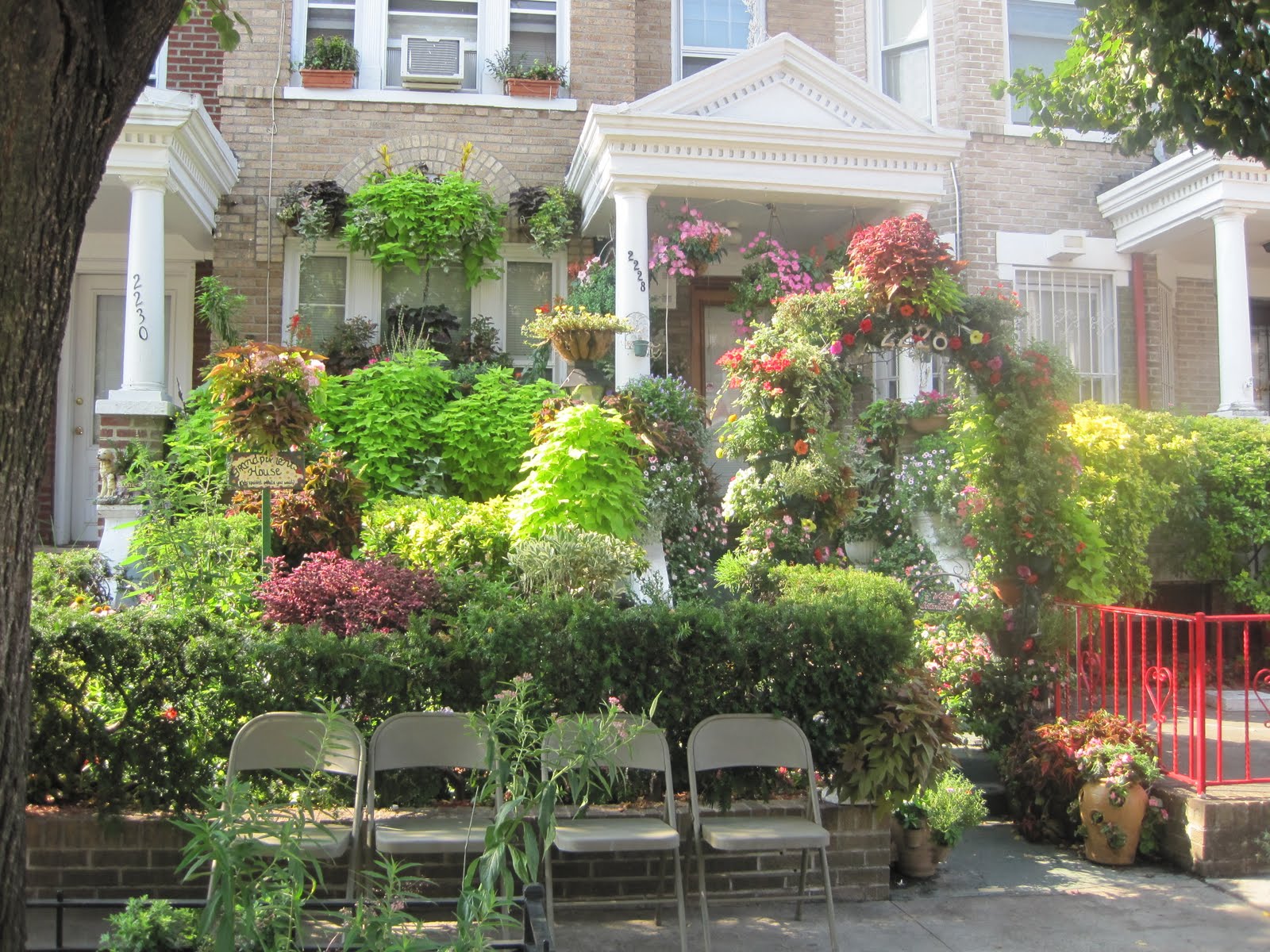

On a block where one person’s house rivals the next, Bob Johnson’s house (above, top photo) stands apart from the rest. An archway covered with flowers and vines acts as a gate, plants line the stoop, the yard is covered with greens, and window boxes populate each window.

Johnson, a resident of Vanderveer Place for 39 years, is very involved in the block association, and says a lot of people stop by his yard to take pictures of the arch. His garden has potato plants, petunias and “quite a few perennials.”

As one of the longest residents on the block, he says, “I call myself ‘the mayor.’ Everyone knows each other. It’s a very vibrant block association.”


Avery, who has been president of the association for four years, but a resident of the block for 35, agrees: “It’s just a nice little block.”

Her own garden has potato plants, petunias, snowdrops and Black Eyed Susans. “It makes the house and the block look beautiful and that’s something you strive for wherever you live,” she said. As for Brooklyn, she adds, “It’s the garden spot of the world.”

Monday, August 17, 2009

Brooklynite Turns Job Loss Into Green Opportunity


With all the recent talk about job loss and unemployment, it’s easy to get discouraged. But for one Boerum Hill resident, losing her job was an opportunity to follow her passion.

Jessica Pichardo grew up in the Bronx and moved to Brooklyn four years ago. She worked as an investment banker for 10 years after she graduated college, but was laid off last year. She decided not to look for another job in a field she wasn’t passionate about.

“I always saw myself opening up a restaurant... you know, after I have children, once life is a little calmer, kind of as a side project,” she said. But after losing her job, she said she realized, “I had nothing but an open opportunity to chase my dream. I still have youth on my side, and I said, ‘Now’s the time to do it.’”

So she set to work on a concept, found a location, and after about a year of planning, Pichardo opened the Linger Café and Lounge last month.

Linger is “first and foremost a really cozy neighborhood spot for people to feel that they can come here throughout the course of the day,” Pichardo explained. During the week (except for Monday), she opens at 9 a.m. for morning coffee and pastries, offers lunch and then small plates for dinner, closing at 10 p.m. On the weekends it is open until 1 a.m. and from 10 a.m. to 6 p.m. on Sundays.

She saw a need in her own neighborhood (she lives four blocks from Linger, which is on Atlantic Avenue between Third and Fourth avenues) for a place to go that was relaxed and familiar, to hang out or have a drink. “I’m offering a really chill, sort of comfortable environment for you to just unwind and relax.”

Pichardo didn’t just want her new endeavor to be welcoming, she also wanted it to be as low-waste as possible.

“I’m doing my best to run a green operation here. We have energy-saver equipment, low water usage in the bathroom, all of our packaging is biodegradable and fully compostable,” she explained. She also arranged with a trash company that picks up food scraps to compost them off-site.
“We have a minimal waste kitchen. The only things we throw out are rubber bands and maybe some wood from crates. Everything else is either recycled or composted.”

Everyone who works at Linger lives in Brooklyn, all the artists to be featured on the walls are local, and live music on Saturdays is provided by local bands. Pichardo purchases produce from farms upstate, tea and coffee that is fair trade and organic, and only offers local wine and beer.

“If there are little things I can do, why not? You want to make a positive impact on the world, it’s important to pass down some good information, because otherwise what’s the point?” she said. “At the end of the day, it’s really important to me to leave this world a better place than when I entered it.”

Because the food is local, the menu changes often, and Pichardo (who cooks all the food) wants to be flexible. “One of the most important things that I’m doing is remaining adaptable: getting customer feedback, interacting with people, hearing from them what they like, what works and what doesn’t work,” she said. “If people want more of something, I’m going to do it and I’m not going to stick with something if its not working.”

Pichardo is confident that this adaptability and the absence of anything like Linger in the neighborhood will ensure its success. Her concept is symbolic of a larger trend: The fast-paced attitude in the country has become slower now that so many people are forced to re-evaluate their lives.

“In the last few years you have all this corporate greed, the whole economy basically coming to shatters because of the financial industry — it forces people to really stop and realize, ‘Hey, why am I chasing the dollar? What is that getting me at the end of the day?’” Pichardo said. “It’s definitely time to stop and smell the roses.”

Pictured above, left to right: Jessica Pichardo with Jessica Waterman, Melissa Detroy and Janessa Williams, three of her staff members.

Back to homepage

Thursday, June 11, 2009

Planting Trees on Atlantic Ave


The Atlantic Avenue Betterment Association and the Teen Tree Corps of Project ReGeneration teamed up in a beautification project of two blocks on Atlantic Avenue: one block between Bond and Hoyt streets, and another between Court and Clinton streets. This photo shows Teddy Francis, program director of Project ReGeneration, with Curtis Cruz and Trish Holt.

Photo courtesy of Atlantic Avenue Betterment Association

Back to homepage

Tuesday, March 24, 2009

In Tough Economic Times, Going Green Is Still Possible

Sure, you want to go green. You’d really like to install solar panels on your brownstone, but you’re a little wary of the price. But did you know that you could get a rebate, tax credits and a property tax abatement? That’s where Rob Ashmore comes in.

He’s the founder of Aeon Solar, a company that installs solar panels in New York, New Jersey, California and Colorado. And if you want to get panels for your home or business, Ashmore will take care of everything for you.

One of his clients is Rolf Grimsted, who runs the mom-and-pop realty company R & E Brooklyn, with his wife. When retrofitting his property at 93 Nevins St. in Boerum Hill, he wanted to make it “what we thought the new urban home should be,” which was as green as possible.


The building (right) is made up of two townhouses, both of which Ashmore fitted with solar panels. “It was one of the first green choices we made,” Grimsted said. The building has good southern exposure, he explained, which makes it “well-situated” for solar power.

Grimsted also installed radiant heating in the floors and sourced as many of the materials as locally as possible. The townhouses have health benefits from the clean filtered air in the building. It’s so healthy that the American Lung Association awarded it Health House certification.

Ashmore explained that the original cost for two solar panel systems was $27,000 each. New York state offers a rebate at a rate of $4 per watt for the first 5,000 watts and $3 per watt for the next 5,000 watts. Since these systems were 2,700 watts each, the rebate was $10,800 per system, making the after-rebate cost of each system $16,200. Grimsted then got a state tax credit of 25 percent, or $4,050, per system. After subtracting that from the after-rebate cost ($12,150), he got a federal tax credit of $3,645, or 30 percent.

The rebate and tax credits took the cost of each solar panel system down to $8,505. But the incentives don’t stop there, Ashmore said. Grimsted then gets a property tax abatement of 35 percent or $2,976.75, split up over the next four years. So each year, he will have a property tax abatement of around $744, making the actual cost of each system to be about $5,528.

And that doesn’t even include the money saved on each townhouse’s electric bill over the next 30 years. Ashmore said the electric bill will be about $75 less per month, per system.

Aeon Solar’s next project is installing solar panels on a brownstone on Columbia Heights in Brooklyn Heights. This system costs $70,000, and after the rebate, tax credits and property tax abatement, the end cost will be $16,640, Ashmore said. “The savings on their Con Ed bill will eat away at that cost, typically in about five years,” he added. After that, “All the power that system produces is free.”

So, as it turns out, it pays to be green.

Photo courtesy of R & E Brooklyn