Showing posts with label Bed-Stuy. Show all posts

Thursday, March 24, 2011

Pick Up Free Trees at Locations in Brooklyn From MillionTreesNYC

MillionTreesNYC will be giving away free trees at six Brooklyn locations now through June. Residents can attend any of the giveaways to pick up one free trees per household. Simple tree planting and caring instructions come with every tree, you just need a place to plant, a shovel and access to water.

Trees can be planted on private properties such as front and back yards, community gardens and faith-based centers throughout New York City with permission of the property owner. Trees must be planted in the ground, rather than in a planter or a container, and all MillionTreesNYC trees must be planted within the five boroughs of New York City.

Emily Laskodi, who works for MillionTreesNYC and will be staffing the first Brooklyn giveaway this Saturday, said that the trees weigh about 30 lbs and are about 7-8 feet tall. “We suggest people bring either a cart to transport them or a car, or a strong back!” she noted in an email message. “Generally the events are very successful — sometimes there will be a line of people waiting before the event starts — no trees will be given away before start time — and other times there will be a steady flow throughout the 2 hours. Any leftover trees after 12 p.m. will be given to people who want additional trees or the community partner will be responsible for distributing them.”

Here is a list of the Brooklyn giveaways:

March

Green Fort Greene & Clinton Hill and FAB Alliance Tree Giveaway
March 26, 10:00 a.m. to noon
Putnam Triangle, Putnam Ave. and Fulton St.
300 trees — cherry trees and dogwoods

April

Green-Wood Cemetery Tree Giveaway
April 16, 11:00 a.m. to 1:00 p.m.
500 25th St.
100 trees — redbud, carolina silverbell, cherry and bur oak

Bedford Stuyvesant Restoration Corporation Tree Giveaway
April 23, 1:00 p.m. to 3:00 p.m.
Restoration Plaza, 1368 Fulton St
130 trees — redbud, magnolia and pear trees

May

Grand Street Campus Tree Giveaway
May 1, 10:00 a.m. – noon
850 Grand St.
300 trees — eastern redbud, kastura, dogwood, magnolia and pear trees

Neighborhood Housing Services of East Flatbush Tree Giveaway
May 7, noon – 2:00 p.m.
Holy Cross Church School Yard, 2530 Church Ave.
200 trees — serviceberry, katsura, dogwood, magnolia, pear, bur oak and littleleaf linden trees

June

Cypress Hills Local Development Corporation Tree Giveaway
June 4, 11:00 a.m. to 1:00 p.m.
Blessed Sacrament Church, 198 Euclid Ave.
250 trees — eastern redbud, cherry and callery pear trees

The giveaways are sponsored by American Express and JetBlue.

Launched in 2007 by the New York Restoration Project (NYRP) and the New York City Department of Parks & Recreation, MillionTreesNYC is one of the goals set forth under Mayor Bloomberg’s PlaNYC, the city’s long-term sustainability blueprint. MillionTreesNYC is a public-private initiative with an ambitious goal — to plant and care for one million new trees across the city’s five boroughs by 2017.

Wednesday, December 8, 2010

Local, Sustainable Food For St. John's Bread & Life Holiday Drive

St. John’s Bread & Life, the largest soup kitchen in Brooklyn, is currently seeking donations for its 13th annual Sponsor-A-Family holiday drive, which provides toys to more than 5,500 children and a Christmas meal to more than 2,000 families.

This year, the food given to those families will be locally sourced from three farms in upstate New York. Among the items provided to each family will be an antibiotic-free cooked turkey, potatoes, vegetables and cranberries. The baked goods, bread and cookies, will be produced with natural ingredients from local bakeries.

“Our goal is to provide the best and most nutritious food to our guests while contributing to the sustainability movement and to the local economy,” said Executive Director Anthony Butler.  “We started buying food from local farmers more than five years ago [for our soup kitchen] and we have found the process to be a great success. We receive fresh ingredients that are nutritious and taste great. And, we’re able to keep our own costs down while helping farmers who are also in need.”

St. John’s Bread & Life, located in Bed-Stuy, serves more than 2,000 hot meals daily. Its Mobile Soup Kitchen provides an additional 500 hot meals to people in two Brooklyn and Queens neighborhoods. To make a donation, please call (718) 574-0058 or visit www.breadandlife.org.

Wednesday, August 25, 2010

Adopt-A-Farmbox: Empowering Brooklyn to Grow Its Own Food


Lately, it seems as though so many people talk about fresh, local or organic food that everyone must have access to it. In fact, there are neighborhoods in New York City that can be characterized as “food deserts” — areas with little or no access to food needed to maintain a healthy diet.

This is where Adopt-A-Farmbox comes in. A new project of Bed-Stuy couple Aki and Ronald Baker through their sustainable design company Baker Design and Build, it partners with schools and community organizations to donate farm boxes: plots of soil enclosed by 100 percent recycled wood in which to grow food.

“If we can empower people about food, what they eat and how that’s going to bring change into their lives, we can encourage them to take charge of their health, their community and their environment,” said Aki, a nutritionist and yoga instructor.

The boxes are custom made, depending on the size and layout of the space they are intended for. If the boxes are built at a school, they fit into the classroom structure. “We know public school teachers have a lot to do already — what we’re trying to do is make it easy for teachers to be able to integrate it easily into the curriculum they already have,” Baker explained. “Kids need to be able to think about [healthy eating] in every aspect of their lives.”

Baker Design and Build will donate all the materials to build and sustain the farm boxes, including the wood for the box structure, organic soil, organic seeds and plan layouts. They also provide consultation on seed placement optimization, soil composition, vegetable and fruit varieties, educational program integration and a standard based curriculum.

Currently, the project is in its early stages, with boxes being built and funds being raised to build more. Adopt-A-Farmbox will soon have a presence at the Brooklyn Brownstone School, P.S. 11 Purvis J. Behan Elementary School, P.S. 307 Daniel Hale Williams Elementary School, the Green-Hill School and LaunchPad creative gathering space, all in Brooklyn. They have one school partnership in Queens and one in Manhattan.

Right now the first boxes are at Community Counseling and Meditation’s Georgia’s Place in Brooklyn, a supportive housing facility for the mentally ill. There are four boxes there, Baker said. She explained that once the boxes are built and the soil is put in, the soil has to settle. Seedlings for new boxes will be started in February and taken outside to plant in April. During the fall and winter, workshops will be held in health, nutrition, farming and composting.

In the meantime, the Bakers are fundraising to cover the cost of the boxes through Kickstarter, an all-or-nothing based fundraising web site, which awards a project money only if it is fully funded by pledges. Adopt-A-Farmbox’s goal is to reach $10,000 by Sept. 11. As of Wednesday afternoon, 48 backers had pledged a little more than $3,500.

Money will also be raised through a party on Sept. 11 in collaboration with theCOMPOUNDbrooklyn, a social experiment designed by a collective of artists, activists and local businesses, in which they throw parties in order to raise funds for good causes. “Back-to-School @ theCOMPOUNDbrooklyn with Adopt-A-Farmbox” will be at 1281 Atlantic Ave. from 3 p.m. to midnight on the 11th.

Baker said they are also talking to council members to secure more funds for the project.

“[The response] has been overwhelmingly positive [so far],” Baker said. “Our hope is to empower people … using food as a catalyst for social change. Food is something that connects us together. We all have to eat.” 

Photo courtesy of Adopt-A-Farmbox

Friday, August 6, 2010

Flatbush Block Claims Title of Brooklyn's Greenest Block


Every year, the Vanderveer Place Block Association enters its block — on Vanderveer Place between Flatbush Avenue and East 23rd Street in Flatbush — in the Brooklyn Botanic Garden’s (BBG) Greenest Block in Brooklyn Contest. And every year, the block comes in first, second or third.

“We are passionate about this contest,” said Olivia Avery, president of the block association. This year, Vanderveer Place took top honors in the residential category — the third time it’s done so in the contest’s 16-year history, Avery said with a smile.

The 2010 winners were announced at a press conference Wednesday at the winning block. BBG’s community environmental horticulture program, GreenBridge, holds the contest every year, with support by the Brooklyn Community Foundation.

“We had incredible participation across Brooklyn,” said BBG President Scot Medbury, who noted that 220 blocks from 20 neighborhoods participated in the contest. “It’s a reminder of the incredible growth of this borough. Brooklyn is famous for its ‘can do’ attitude and its one-of-a-kind style.”


Residents gathered among the flowers and greenery joined by Borough President Marty Markowitz, GreenBridge director Robin Simmen and Brooklyn Community Foundation President Marilyn Gelber, to recognize winners in all categories.

“Vanderveer Place has set a new standard,” Gelber said. “In a small way this block reflects everything about Brooklyn.”

Other winners were: Hoyt Street between State Street and Atlantic Avenue in Boerum Hill, which took top honors in the commercial category; Bainbridge Street between Malcolm X Boulevard and Stuyvesant Avenue in Bedford-Stuyvesant, which won for best street tree beds; Brooklyn’s Finest Garden, on Lefferts Place between St. James and Grand Avenue in Clinton Hill, which won best community garden streetscape; Sam Hall on State Street in Boerum Hill, which won for best window box; and Burrito Bar in Prospect Heights, which won greenest storefront. 


A panel of more than 30 judges look at a number of criteria including color and total visual effect, citizen participation, variety and suitability of plants, soil condition, use of mulch, street tree and tree bed care and other good horticultural practices. The panel, made up of professional horticulturalists from the garden and other greening organizations throughout the city, visited the blocks from mid-June through July.

“Today blocks like Vanderveer carry on Brooklyn’s green tradition,” said Markowitz. “When we plant seeds all of Brooklyn blooms.”


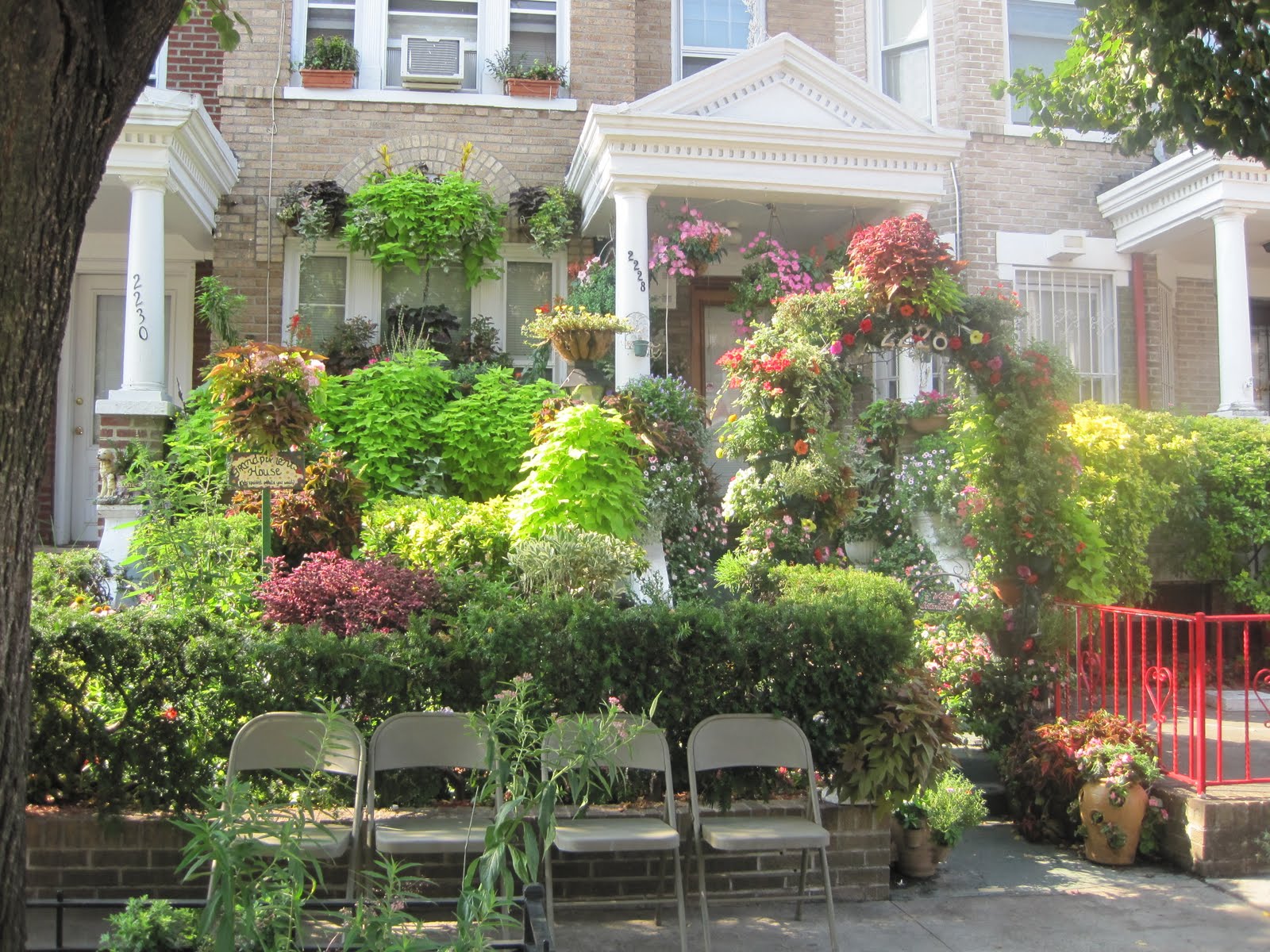
On a block where one person’s house rivals the next, Bob Johnson’s house (above, top photo) stands apart from the rest. An archway covered with flowers and vines acts as a gate, plants line the stoop, the yard is covered with greens, and window boxes populate each window.

Johnson, a resident of Vanderveer Place for 39 years, is very involved in the block association, and says a lot of people stop by his yard to take pictures of the arch. His garden has potato plants, petunias and “quite a few perennials.”

As one of the longest residents on the block, he says, “I call myself ‘the mayor.’ Everyone knows each other. It’s a very vibrant block association.”


Avery, who has been president of the association for four years, but a resident of the block for 35, agrees: “It’s just a nice little block.”

Her own garden has potato plants, petunias, snowdrops and Black Eyed Susans. “It makes the house and the block look beautiful and that’s something you strive for wherever you live,” she said. As for Brooklyn, she adds, “It’s the garden spot of the world.”

Thursday, August 5, 2010

Bed-Stuy Duo Raises Funds to Launch Organic Market

Residents in Bed-Stuy have limited options when it comes to organic and locally produced foods; eight in 10 food stores in the neighborhood are reported to be bodegas. In response to this lack, two women, Darell Brown and Evelyn Oliver, together founded Organic Bed-Stuy, a grocery that will not only bring organic foods to the under-served neighborhood, but will also educate residents about healthy eating.

“We’ve been developing the idea for over a year now,” said Brown, who grew up in Bed-Stuy, moved to other neighborhoods in the borough and then came back. “Once I moved back I found out that this is something that is really needed.”

To help get their project off the ground, Brown and Oliver turned to Kickstarter, an all-or-nothing based fundraising web site, which awards a project money only if it is fully-funded by pledges. Organic Bed-Stuy’s goal, set in the middle of June, is $20,000, and the deadline to reach it is Monday. Click here to visit Organic Bed-Stuy's Kickstarter page.

The store will still open even if the Kickstarter goal isn’t reached, said Brown, but it might take longer to do without the fundraising. The project will be funded in part through winnings from the Brooklyn Public Library’s Power Up! business plan competition, from which they took home second place and $5,000 earlier this year.


Organic Bed-Stuy will offer one-stop-shopping organic goods, with fruits and vegetables sourced locally from a farm in New Jersey. Right now, says Brown, residents in the neighborhood have to travel to several different stores or leave the area completely in search of organics.

“People want to keep their dollars here but end up having to go outside the neighborhood,” she said
.
Because Bed-Stuy is a community plagued by higher than normal rates of diabetes, obesity and heart disease, Brown said she wants to offer nutrition and cooking classes to the community. She also hopes to start a farm exchange with their farming partner, wherein people grow produce on his unused land.

While searching for a permanent location — Brown said she has two in mind — she is operating at the Malcolm X Farmers Market to get the word out to residents.

She and Oliver have reached out to community organizations throughout the process and she says, so far “the response has been great.” From the time they developed their business plan to when they started searching for locations, the response has increased threefold.

“A lot of people really want to see this happen,” she said.

Thursday, May 6, 2010

Bette Midler Celebrates Arbor Day in Brooklyn

Last Friday was Arbor Day, and to commemorate the holiday, New York Restoration Project founder Bette Midler (above, center) joined NYC Parks Commissioner Adrian Benepe and 100 MillionTreesNYC corporate volunteers (sponsors were The Home Depot Foundation, Toyota and BNP Paribas) to plant trees in Bedford-Stuyvesant.
Photo by Amanda Schwab / Starpix

Back to homepage

Friday, April 16, 2010

Bed-Stuy Artist Works With Found Styrofoam

I recently interviewed Bed-Stuy artist Chris Spadazzi at his studio at the Brooklyn Navy Yard, who works with styrofoam he collects from the East and Hudson rivers. "For anyone who loves the ocean, or nature for that matter, it's terrible to see how we've irreversibly polluted our environment. The foam pieces are just tangible evidence," he said.


Spadazzi is pictured above with his current project, a piece that is about five feet tall, four-and-a-half feet wide and two feet thick. He says it's the biggest he's worked on thus far.


Read the full story here.


Back to homepage

Monday, February 1, 2010

City Tech Professor's Solution to Climate Change: Resources From Space

City Tech physics Professor (and Bed-Stuy resident) Gregory L. Matloff recently released a new book he co-authored called Paradise Regained: The Regreening of Earth.
The book outlines how space resources and space-based power generating systems can work together with Earth-based conservation to meet industrial needs and forge a sustainable future.
Matloff co-wrote the book with Les Johnson, deputy manager of the National Aeronautics and Space Administration’s Advanced Concepts Office at the George C. Marshall Space Flight Center in Huntsville, Al.
“With an ever-increasing share of the human population making the transition to the ‘developed’ world,” said Johnson in a press release, “will come increasing stress on the Earth’s environment, natural resources and ability to produce enough food. The modern environmental movement is tackling these problems head-on by promoting energy efficiency, recycling and renewable resources. While these strategies and technologies are vital, they will be woefully insufficient to provide for a prosperous, long-lived global society with a moderate-to-high standard of living.”
The solution to a progressively worsening environmental situation and its negative impact on society will require “drawing upon the vast energy and material resources that space alone can provide,” said Matloff in a press release. “Doing so will enable us to create a cleaner, healthier environment essential to sustaining life on Earth far into the future.”
Paradise Regained is published by Springer Science & Business Media and is available on Amazon here.

Back to homepage  

Friday, December 18, 2009

Recycling Outreach in Brooklyn

I’m sure many of you, while dutifully putting your paper recyclables in the green bins, and metal, glass and plastic recyclables in the blue bins, have often wondered: When the Department of Sanitation (DSNY) picks these up, do they really go to a recycling center?

According to David Hurd, director of the Office of Recycling Outreach and Education (OROE) at the Council on the Environment of New York City (CENYC) — which is not a city agency — they do.

“So many New Yorkers want to believe that the Department of Sanitation is actually not recycling the recyclables that they pick up,” he said. “That’s absolutely false.”

In some cases, people are recycling less or not recycling at all. So, through OROE, “What we try to do is basically get people to understand the program,” he explained. “To debunk the classic myth.”

CENYC, which is almost 40 years old, created OROE in 2006. Five outreach coordinators tackle each borough by community district, using a Residential Waste Characterization Study conducted by DSNY to target the districts that have low recycling diversion rates first.

Brooklyn’s recycling outreach coordinator, Jae Watkins, says of her approach, “I try to find active community groups in the districts.” At their meetings she does a presentation with samples, “a collection of things that are both recyclable and not recyclable. I clear up the confusion about the program.”

Much confusion is generated from what DSNY does and does not collect. Plastic bottles are the only type of plastic that can be recycled; yogurt and takeout containers are not recyclable. Milk cartons seem like they should go out with paper and cardboard, but they actually get recycled with plastics and metals. Also, household items that are at least 50 percent metal — pots and pans, irons, toasters and wire hangers — can be recycled.

Watkins mostly speaks to building owners, giving them tips about ways to make recycling easier in their buildings, such as making sure their bins are in places that are well-lit and clean.

Of the neighborhoods Watkins has tackled so far, she said, “I started out in the Williamsburg/Greenpoint area a couple of years ago and then I moved to Bed-Stuy, and then Bushwick, and now I’m working in the CB 2 area, Fort Greene.”

Once she’s established herself in a community district, Watkins says she remains a resource for recycling questions and requests. She gets calls every once in a while from building owners who are looking for more ways to educate their tenants, such as getting signs in languages other than English.

“A lot of people, they have all these questions but they don’t know who to ask,” Watkins said.

Though she has covered a lot of ground in her three years at CENYC, Watkins still has a ways to go. “It takes six months to really get in good in a community district, and there are 18,” she said.

“What I think makes us effective is that staff really does try to completely absorb the neighborhood,” Hurd said. “Not only do we use data from the Department of Sanitation study, but we also use demographic data from the Department of City Planning to identify larger target population groups.”

OROE also identifies the other opportunities that exist in neighborhoods, such as composting, appliance repair shops, or shoe repair shops, Hurd explained, to make objects last longer rather than be thrown out.

“We’re trying to get people to remember that whole concept, that garbage is a choice that we make,” he continued. “There are a lot of things that are perfectly good but we decide that they are no longer good for us. We try to talk about changing that mentality where we can.”

For more information about recycling, visit www.cenyc.org.

Back to homepage

Monday, September 21, 2009

Markowitz Joins Bette Midler to Open Community Garden in Bed-Stuy

On Thursday, September 17, Brooklyn Borough President Marty Markowitz joined Bette Midler’s New York Restoration Project (NYRP) for the opening of Brooklyn’s new and refurbished Bedford-Stuyvesant Community Garden. The Garden was designed by renowned New York landscape architect Ken Smith and underwritten by long-time NYRP supporter, Dr. Leslie Johnson.

“I know that as long as this garden is running strong, the grass will always be greener in Bed-Stuy,” said BP Markowitz. “If I may paraphrase one of Ms. Midler’s wellknown songs: ‘Love, it is a flower, and Brooklyn its only seed.'”

In photo (left to right): Drew Becker, NYRP executive director; George Walker, resident; Marcus Calcador, community gardener; Dr. Leslie Johnson; Father Mark Hummel; Ken Smith, architect; Bette Midler, NYRP founder; BP Markowitz.

Photo by Kathryn Kirk

Thursday, May 28, 2009

Squash Seed From Thomas Jefferson Makes Its Way to Brooklyn


As it turns out, not all of Thomas Jefferson’s seeds are controversial. Saturday, one Brooklyn community gardener will take home squash seeds descended from a squash Jefferson planted in the 1800s, as part of the Vegetable Starts Seed Giveaway held by the New York Restoration Project (NYRP).

Jason Sheets, regional director of Brooklyn gardens at NYRP, had the idea for a seed giveaway and first implemented it last year. This Saturday, gardeners from the community will converge on Target Community Garden in Bed-Stuy (below) to collect some of the 2,000 heirloom vegetable seeds donated to
NYRP for the giveaway.

Heirloom seeds, Sheets said, are “seeds that have been around for years and years,” handed down for generations. They’re better in many ways than hybrid seeds you see in garden centers today, because they produce vegetables that “are better tasting, have a historical context and are open pollinated,” he explained. For a vegetable to be open pollinated means that its seeds can be harvested, as opposed to hybrid vegetables, which have sterile seeds.

“More and more people over the last 10 years have been embracing
hybrids because they have built-in disease resistance,” Sheets said. This has brought about the near extinction of many heirloom vegetable plants.

Fortunately, heirloom seeds have become popular in recent years, no doubt helped by the efforts of Amy Goldman, chair of the board of the Seed Savers Exchange, an organization dedicated to “preserving the world’s diverse but endangered heirloom seeds,” she said.

“I have devoted my life to the preservation of our vegetable heritage,” Goldman said. She donated the seeds for Saturday’s giveaway to NYRP, because she wants to educate “this new generation of farmers and gardeners.”

The selection of seeds that will be given out were determined by the gardeners themselves. Sheets said NYRP held a gardener’s gathering in March where community gardeners reserved the heirloom seeds they wanted in their garden.

In case some gardeners aren’t comfortable growing the vegetables from seeds, Sheets will have some seedlings, or vegetable starts, available. These were propagated by Landcraft Environment and will be given away Saturday.

Vegetable starts and seeds will be organic, untreated and not genetically engineered. Types will range from tomatoes, carrots, corn and herbs. Sheets said that an heirloom seed might yield a purple tomato. He hopes that in future years, he will be able to open seed giveaways to the public.

Sheets calls Goldman, an avid gardener who has published many books on the subject, the “queen of heirloom vegetables.”

“We want to get people out there gardening and growing their own food,” Goldman said. “We’re putting seeds in the hands of farmers and gardeners where they belong.”

Jefferson photo courtesy of whitehouse.gov, garden photo courtesy of the New York Restoration Project.

Back to homepage