Showing posts with label garden. Show all posts

Tuesday, March 1, 2011

Chase Away the Winter Blues at the Brooklyn Botanic Garden

It’s been a long, rough winter, and the Brooklyn Botanic Garden (BBG) is offering a “Chase Away the Winter Blues” tour this coming Sunday, March 6 at 1 p.m. From BBG’s web site:

Science has developed some understanding of what causes the “winter blues” — and more important, what helps keep them at bay. Exposure to daylight, even on a cloudy day, can help restore energy, alertness, and contentment.

Over a dozen different kinds of flowers grace the grounds of BBG in late winter. Celebrate the transition from winter to spring by admiring petite, colorful and sturdy blooms that are undeterred by the frosts and snows of March.

Join licensed psychotherapist and veteran BBG tour guide Lynne Spevack, LCSW, for this hour-long, outdoor narrated walk designed to relieve the winter doldrums. Learn what you can do to maintain a sunny outlook through the dark, cold days of winter while discovering the plants and animals that enliven the garden landscape in the depths of winter. This walk is held rain, snow, or shine; dress warmly and wear comfortable walking shoes.

The tour is free with Garden admission, there is no reservation required. Meet in front of the Visitor Center.

BBG also offers free winter weekdays, which last until March 13. As always, admission on Saturdays from 10 a.m. to noon is free (except during special events). For more information visit www.bbg.org.

Wednesday, August 25, 2010

Adopt-A-Farmbox: Empowering Brooklyn to Grow Its Own Food


Lately, it seems as though so many people talk about fresh, local or organic food that everyone must have access to it. In fact, there are neighborhoods in New York City that can be characterized as “food deserts” — areas with little or no access to food needed to maintain a healthy diet.

This is where Adopt-A-Farmbox comes in. A new project of Bed-Stuy couple Aki and Ronald Baker through their sustainable design company Baker Design and Build, it partners with schools and community organizations to donate farm boxes: plots of soil enclosed by 100 percent recycled wood in which to grow food.

“If we can empower people about food, what they eat and how that’s going to bring change into their lives, we can encourage them to take charge of their health, their community and their environment,” said Aki, a nutritionist and yoga instructor.

The boxes are custom made, depending on the size and layout of the space they are intended for. If the boxes are built at a school, they fit into the classroom structure. “We know public school teachers have a lot to do already — what we’re trying to do is make it easy for teachers to be able to integrate it easily into the curriculum they already have,” Baker explained. “Kids need to be able to think about [healthy eating] in every aspect of their lives.”

Baker Design and Build will donate all the materials to build and sustain the farm boxes, including the wood for the box structure, organic soil, organic seeds and plan layouts. They also provide consultation on seed placement optimization, soil composition, vegetable and fruit varieties, educational program integration and a standard based curriculum.

Currently, the project is in its early stages, with boxes being built and funds being raised to build more. Adopt-A-Farmbox will soon have a presence at the Brooklyn Brownstone School, P.S. 11 Purvis J. Behan Elementary School, P.S. 307 Daniel Hale Williams Elementary School, the Green-Hill School and LaunchPad creative gathering space, all in Brooklyn. They have one school partnership in Queens and one in Manhattan.

Right now the first boxes are at Community Counseling and Meditation’s Georgia’s Place in Brooklyn, a supportive housing facility for the mentally ill. There are four boxes there, Baker said. She explained that once the boxes are built and the soil is put in, the soil has to settle. Seedlings for new boxes will be started in February and taken outside to plant in April. During the fall and winter, workshops will be held in health, nutrition, farming and composting.

In the meantime, the Bakers are fundraising to cover the cost of the boxes through Kickstarter, an all-or-nothing based fundraising web site, which awards a project money only if it is fully funded by pledges. Adopt-A-Farmbox’s goal is to reach $10,000 by Sept. 11. As of Wednesday afternoon, 48 backers had pledged a little more than $3,500.

Money will also be raised through a party on Sept. 11 in collaboration with theCOMPOUNDbrooklyn, a social experiment designed by a collective of artists, activists and local businesses, in which they throw parties in order to raise funds for good causes. “Back-to-School @ theCOMPOUNDbrooklyn with Adopt-A-Farmbox” will be at 1281 Atlantic Ave. from 3 p.m. to midnight on the 11th.

Baker said they are also talking to council members to secure more funds for the project.

“[The response] has been overwhelmingly positive [so far],” Baker said. “Our hope is to empower people … using food as a catalyst for social change. Food is something that connects us together. We all have to eat.” 

Photo courtesy of Adopt-A-Farmbox

Friday, August 20, 2010

SIte-Specific Art Installation at Botanic Garden Made of Branches from Invasive Species

This morning, installation artist Patrick Dougherty (above center), who creates whimsical woven structures from saplings and twigs, completed the first site-specific sculpture to ever be commissioned by the Brooklyn Botanic Garden (BBG). 

Dougherty began construction of the large-scale sculpture on Aug. 5 in the Plant Family Collection meadow, and over the next three weeks enlisted the help of about 50 volunteers to build the piece. The finished work is comprised of several structures that resemble huts and are linked together from above by a network of arches.

“It’s a retreat for feral children and wayward adults,” Dougherty said.

Willow branches from the nonnative species salix atrocinerea — designated as an invasive species in New York State — make up the installation. This material was collected from Ocean Breeze Park on Staten Island. It’s supplemented by branches from BBG’s collection of cherry trees.

To build the structures, 30-inch holes were dug into the ground to anchor the foundational branches, and additional material was woven in from there. As the structure got larger, scaffolding was constructed around it so workers could weave up to more than 10 feet.

When thinking of the overall design, Dougherty wanted the piece to “fill the space in an adequate way,” and used a nearby tree whose branches hung above as a guide.

“You’re working as though you’re building a drawing,” he said. 

During the construction process, garden visitors could watch Dougherty and the volunteers build the sculpture. Toward the end of the process, he said, a four-year-old visiting with her mother saw it said, “It looks like natural history!” So Dougherty decided to name the piece, “Natural History.”

The sculpture will be on display in the garden for a year — commemorating the institution’s centennial — so visitors can see it throughout the seasons, said BBG spokesperson Kate Blumm.
“We want to take it down while it still looks good,” said Dougherty.
Dougherty has been constructing large-scale sculptures out of tree branches since the early 1980s, but started making a living at it around 1985, he said.

He’s done more than 200 installations around the world, and for him, the process of making art is as important as the end result. He is also publishing a book of photographs of past projects, called Stickwork.

As is evident by the fact that he involved so many volunteers in his craft, he feels that we all have “stickwork” within us. 

“Kids seem to know everything about sticks, so we all seem to know at one point,” he said.

For more information about the installation process, visit www.bbg.org. For more information about Patrick Dougherty’s work, visit stickwork.net.

Friday, August 6, 2010

Flatbush Block Claims Title of Brooklyn's Greenest Block


Every year, the Vanderveer Place Block Association enters its block — on Vanderveer Place between Flatbush Avenue and East 23rd Street in Flatbush — in the Brooklyn Botanic Garden’s (BBG) Greenest Block in Brooklyn Contest. And every year, the block comes in first, second or third.

“We are passionate about this contest,” said Olivia Avery, president of the block association. This year, Vanderveer Place took top honors in the residential category — the third time it’s done so in the contest’s 16-year history, Avery said with a smile.

The 2010 winners were announced at a press conference Wednesday at the winning block. BBG’s community environmental horticulture program, GreenBridge, holds the contest every year, with support by the Brooklyn Community Foundation.

“We had incredible participation across Brooklyn,” said BBG President Scot Medbury, who noted that 220 blocks from 20 neighborhoods participated in the contest. “It’s a reminder of the incredible growth of this borough. Brooklyn is famous for its ‘can do’ attitude and its one-of-a-kind style.”


Residents gathered among the flowers and greenery joined by Borough President Marty Markowitz, GreenBridge director Robin Simmen and Brooklyn Community Foundation President Marilyn Gelber, to recognize winners in all categories.

“Vanderveer Place has set a new standard,” Gelber said. “In a small way this block reflects everything about Brooklyn.”

Other winners were: Hoyt Street between State Street and Atlantic Avenue in Boerum Hill, which took top honors in the commercial category; Bainbridge Street between Malcolm X Boulevard and Stuyvesant Avenue in Bedford-Stuyvesant, which won for best street tree beds; Brooklyn’s Finest Garden, on Lefferts Place between St. James and Grand Avenue in Clinton Hill, which won best community garden streetscape; Sam Hall on State Street in Boerum Hill, which won for best window box; and Burrito Bar in Prospect Heights, which won greenest storefront. 


A panel of more than 30 judges look at a number of criteria including color and total visual effect, citizen participation, variety and suitability of plants, soil condition, use of mulch, street tree and tree bed care and other good horticultural practices. The panel, made up of professional horticulturalists from the garden and other greening organizations throughout the city, visited the blocks from mid-June through July.

“Today blocks like Vanderveer carry on Brooklyn’s green tradition,” said Markowitz. “When we plant seeds all of Brooklyn blooms.”


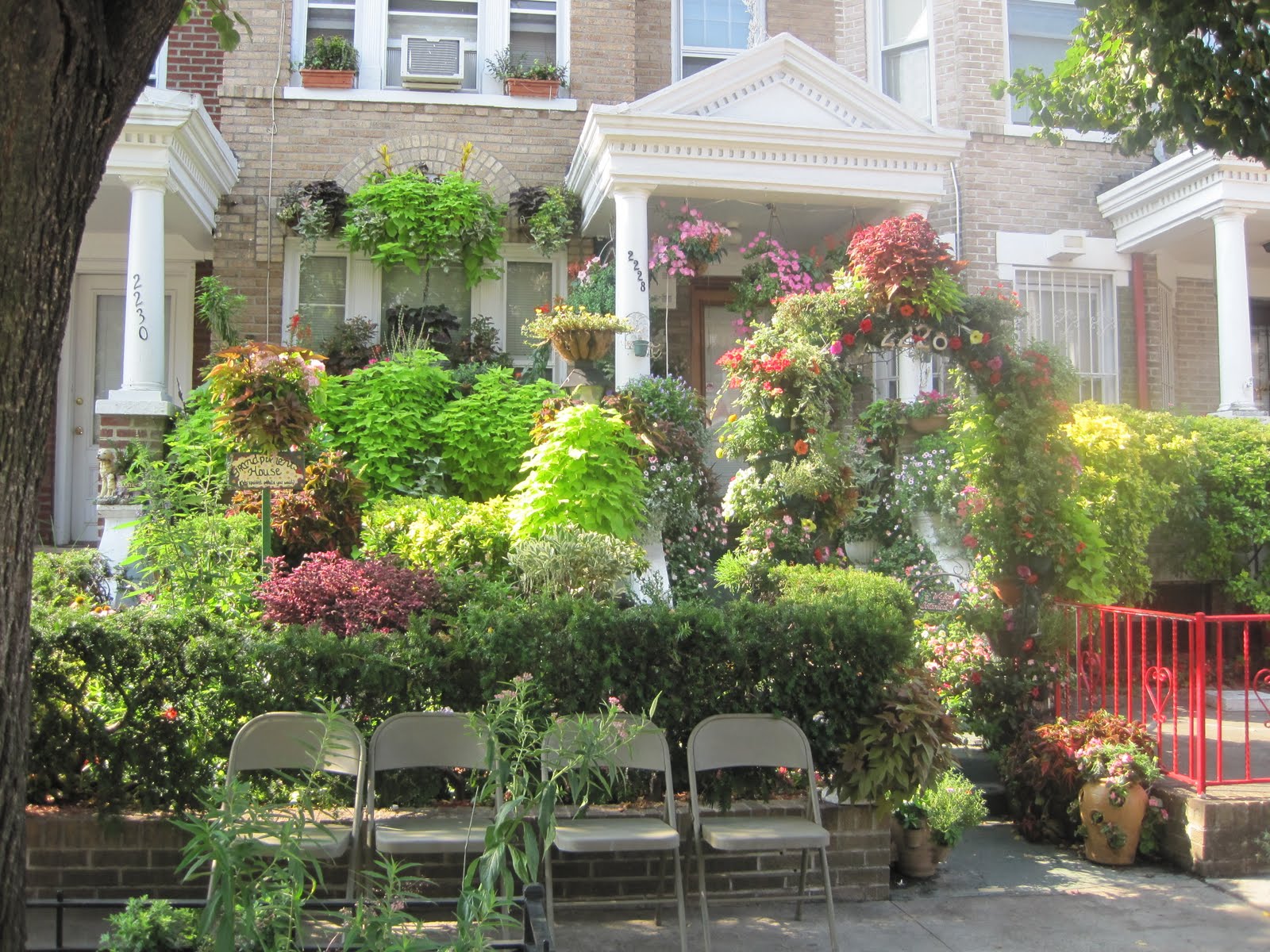
On a block where one person’s house rivals the next, Bob Johnson’s house (above, top photo) stands apart from the rest. An archway covered with flowers and vines acts as a gate, plants line the stoop, the yard is covered with greens, and window boxes populate each window.

Johnson, a resident of Vanderveer Place for 39 years, is very involved in the block association, and says a lot of people stop by his yard to take pictures of the arch. His garden has potato plants, petunias and “quite a few perennials.”

As one of the longest residents on the block, he says, “I call myself ‘the mayor.’ Everyone knows each other. It’s a very vibrant block association.”


Avery, who has been president of the association for four years, but a resident of the block for 35, agrees: “It’s just a nice little block.”

Her own garden has potato plants, petunias, snowdrops and Black Eyed Susans. “It makes the house and the block look beautiful and that’s something you strive for wherever you live,” she said. As for Brooklyn, she adds, “It’s the garden spot of the world.”

Thursday, July 15, 2010

Chicken Keeping Workshops From NYRP, bk farmyards, Just Food

Usually, you don’t need extensive training when introducing an animal into your life. When you acquire a dog or a cat, you can play it by ear or get advice from a friend. But what about a chicken?

Most of us don’t know the first thing about keeping chickens, which is why the New York Restoration Project (NYRP), in partnership with bk farmyards and Just Food, are presenting a workshop series this summer and fall covering the topic.

Dubbed the City Chicken Institute, the series is free and open to the public, and were developed after Rachael Brody, NYRP community outreach garden coordinator, approached bk farmyards — a decentralized farming network that partners with landowners to farm on their land.

The two organizations worked together to “create this amazing, large chicken coop,” Brody said. Built in March at the Brooklyn Schenectady Avenue Community Garden in Crown Heights, it is the largest chicken coop in the city. “We want to engage more of the wider community to learn about chicken-keeping.”

The workshop series is led by bk farmyards’ farmer-in-chief Bee Ayer (below), a full-time urban farmer who keeps chickens in her backyard. The first installment, “Introduction to City Chickens,” took place on June 20.

“It covered basic anatomy, needs of chickens, a little bit of the history of chickens and how to take care of them to be healthy and happy,” said Ayer, adding that the event was a success with about 50 people in attendance.

“We had a great turnout at the first workshop,” said Brody. “People came from all over — the Bronx and Manhattan.”

The next workshop is this Sunday, July 18, from 2 to 4 p.m. at the Brooklyn Schenectady Community Garden. “It’s geared towards elementary school aged children, and so we’ll be doing some creative expression work with the chickens: drawing the chickens and playing some games. They’ll all learn how to hold the chickens,” said Ayer. “There’s a lot of kids that come in [to the garden] all the time. So I wanted to have a formal time that they could come in and do something fun.”

Three workshops will follow throughout the rest of the summer and into the fall. On August 15, attendees will learn how to properly integrate chickens into their gardens and how to build a chicken tractor, which is “like a small pen that the chickens go in that you put on your vegetable bed,” Ayer explained. “The chickens help the vegetable bed because they scratch it up so they prepare a nice bed for planting.”

On September 19, there will be a workshop for people who are more serious about keeping chickens, covering specific aspects of keeping chickens, including the time it takes, costs and where you can keep your birds. The last workshop will be on October 17 and will be about preparing chickens for the winter.

A Garden Full of Hens

Three years ago, Ayer was working at La Familia Verde, a coalition of community gardens in the South Bronx, and was having trouble finding a farmer who would deliver fresh eggs. She decided to start a chicken operation herself and sell the eggs. So she traveled to Costa Rica and worked on a farm to learn about chicken keeping and then came back to take classes and workshops with Just Food. Since then she has been interested in “pushing the envelope of what urban livestock can be.”

After opening the coop in March, Ayer visits every morning and evening to care for its 49 hens. There are eight different types of chickens, most of which lay every day. “There are some of them that lay [an egg] every three days and a couple of them lay one egg every two days,” explained Ayer. All in all, she gets around 36 eggs a day, which are sold through bk farmyards’ CSA (Community Supported Agriculture).

“That’s how we sell most of our eggs and with the extras we just sell them to people in the neighborhood,” said Ayer. “There are a lot of people in the neighborhood who want them.”

The hens roam free around the garden during the day, a surprising sight for someone walking by on the sidewalk. “Chickens really need space. To be healthy and happy I think it’s really important for chickens to be able to run around,” says Ayer. The coop is at the back of the garden, where the chickens go to roost and nest.

For someone who wants to start their own coop, Ayer says, “chickens are flock animals, you definitely need more than one. I recommend three. And then probably no more than 50 without a rooster.”

Though some people raise chickens on their roofs, she says, “I feel very strongly that chickens need to be connected to the soil… If they have a green roof it’s a little different, like Eagle Street Farm in Greenpoint. They have chickens on their roof, but it’s a green roof. Chickens are very sensitive to wind, especially during the cold months, so it’s a little hard on a roof.”

Just like any other pet, “[keeping chickens] is a lot of work and it can be really expensive. Especially if you buy organic feed.” But, Ayer says, “It’s really fun, it’s really enjoyable. I have a pretty stressful life even, as a farmer. It’s nice to be here at the beginning and the end of the day… I have chickens in my backyard as well. I love in the morning just sipping coffee and watching the chickens.”

To register for the chicken workshops, contact Rachael at
rbrody@nyrp.org or by calling (212) 333-2552. Pre-registration is required, space is limited.

Friday, July 2, 2010

Native Plant Month at Brooklyn Botanic Garden

During the month of July, the Brooklyn Botanic Garden (BBG) will highlight the New York Metropolitan region’s native flora, displaying its beauty, explaining its importance, drawing attention to its plight, and providing simple ways to help in its restoration.

In 1911, the “Local Flora Section” was the first garden to open to the public at BBG. It’s now known as the Native Flora Garden. Following is a list of programs for Native Plant Month at the garden.

Curator's Tour: The Native Flora Garden with Uli Lorimer
Thursday, July 8, 5–6 p.m.
Curator Uli Lorimer will lead a tour of BBG’s 99-year-old Native Flora Garden, which represents nine local plant communities, including the distinctive kettle pond and pine barrens habitats. Get behind-the-scenes insight into this extraordinary garden and how it has evolved since 1911. Learn about the visionary work of BBG’s founders in researching and documenting native plant life, both in the Garden and the greater metropolitan area. Fee and registration required; call (718) 623-7220 or go to bbg.org/classregistration. Registration deadline is Wednesday, July 7, but there’s limited space, so register now.

Talk: Bringing Nature Home
Thursday, July 8, 6:30 p.m.
With as many as 33,000 species imperiled in the U.S. alone, it is clear that citizens must change their approach to gardening and landscaping if they hope to share space with other living things. Ecologist and author Doug Tallamy will talk about the key role native flora must play in the restoration of our landscapes. Only by supporting a large, healthy diversity of insects that coevolved with native plants can we keep herbivores in balance and gardens aesthetically pleasing. Advance registration is recommended but seats may be available at the door. Call (718) 623-7220 or go to bbg.org/classregistration. There will be a fee for this event.

Field Trip: Native Plants and Restored Natural Areas: A Field Trip to Staten Island
Saturday, July 10, 8:30 a.m.–2:30 p.m.
This day trip, led by restorationist Cindy Goulder, begins with a private guided tour of the Greenbelt Native Plant Center, the NYC Parks Department’s 13-acre nursery and greenhouses on Staten Island. See how hundreds of native plant species are propagated and grown from seed and learn principles underlying native plant cultivation. The Sweetbrook Stream and Wetland Restorations help recover the ecological health and function of urban waters, thanks to the indigenous wetland and upland plant species intentionally placed to increase local plant diversity and wildlife habitat. The Salt Marsh Restorations at Old Place Creek have reestablished many acres of tidal marshes after centuries of displacement by agricultural and industrial uses. Learn how invasive plants were removed and zones of marsh and maritime woody plants reintroduced to this estuarine community. Fee and registration required; call (718) 623-7220 or go to bbg.org/classregistration. Registration deadline is Wednesday, July 7.

Class: Great Natives for Tough Places
Sunday, July 11, 10 a.m.–12:30 p.m.
This workshop, led by garden designer Joan McDonald and based on the BBG handbook Great Natives for Tough Places, identifies gardening challenges caused by city buildings, impermeable surfaces, rainwater runoff, construction, and other disturbances that compact and degrade soil. Students will explore solutions with five spectacular designs using unusual native plants chosen for their ability to thrive in urban environments. Students will receive a copy of Great Natives for Tough Places. Fee and registration required; call (718) 623-7220 or go to bbg.org/classregistration. Registration deadline is Thursday, July 8.

Workshop: Gardening with Native Plants
Tuesday, July 13, 6–9 p.m.
Why are native plants important, and which ones are best for a garden? What does “native” really mean, anyway? Explore these questions with native plant authority Uli Lorimer, curator of BBG’s Native Flora Garden and learn how a garden can reflect the region’s — even a densely populated urban region’s — spectacular natural environment. Fee and registration required; call (718) 623-7220 or go to bbg.org/classregistration. Registration deadline is Monday, July 12.

Class: Edible Native Plants in Brooklyn
Saturday, July 18, 2–5 p.m.
Wild ginger, spicebush, fiddlehead ferns, wild leeks—these are just a few of the delicious vegetables and seasonings native to the region. Unlike conventional crops, many of the northeastern edible native plants are excellent for shade gardens, and most are perennials that will feed people year after year. Learn from local food specialist Leda Meredith (and Park Slope resident) which edible native plants will thrive in a garden and how to grow, harvest, and use them. Fee and registration required; call (718) 623-7220 or go to bbg.org/classregistration. Registration deadline is Thursday, July 15, there’s limited space, so register now.

Visit www.bbg.org for more information about Native Plant Month

Monday, June 28, 2010

Volunteers Build Greenhouse in East New York


Almost 50 volunteers gathered in East New York on Saturday to build a Greenhouse on a recently acquired lot behind Euclid 500 Garden. The participants assembled planters with fruits, vegetable and herbs — which will be donated to a local food bank — and also built picnic tables and painted a mural. The project was sponsored by the Laurie M. Tisch Illumination Fund, a foundation whose mission is to increase access and opportunity for all New Yorkers. The project was held just two days before the National Conference on Volunteering and Service, which is going on in Manhattan today through June 30. 

Photos by Lauren Farmer

Friday, June 11, 2010

Rooftop Garden at Sixpoint Craft Ales in Red Hook

If you take a tour of Sixpoint Craft Ales in Red Hook, you can expect to see the inner workings of how beer is made, and you’ll be able to sample some of that beer. You’ll also be able to see the chickens that reside in a pen on the roof of the brewery.

Yup, Sixpoint keeps chickens. They cluck happily amidst a rooftop garden full of lettuce greens, kale, zucchini, corn, radishes, cauliflower, peppers, string beans, chamomile and of course, hop vines.

The garden is a project of brewery president Shane C. Welch, who founded Sixpoint in 2004 and has been gardening since childhood. “My parents used to grow vegetables when I was a kid, and I used to grow when I was in high school and college,” he said. “I used to love to grow corn, watermelons, pumpkins, and radishes. I kept the tradition alive at [my parents’] home well after they stopped vegetable gardening themselves.”

Welch started the garden at the brewery so he could repurpose old materials. “We had all of these used, broken kegs laying around, and then we thought to ourselves — ‘Whoa, couldn’t we just cut the tops off these things and turn them into planters? That would be sweet! Fresh food for the brewery, and lots of beauty as well.’”

Welch and his staff of four brewers, two salesmen and an engineer visit the garden at lunchtime for sustenance. Right now, “you’d find just what you’d get at a farmers market,” says brewer Dan Suarez: fresh greens and eggs from the four hens.

The keg planters are topped with coffee beans hulls from Stumptown café in Manhattan, Suarez explained, which help the plants grow. Other features of the garden include a rain collection system made of old kalamata olive barrels and a composting system.

In the future, produce gleaned from the garden won’t just be for lunch. “I hope to make a botanical beer,” said Suarez, picking some chamomile and smelling it. “I definitely want to brew at least a couple of beers with the stuff we have here.” But the hop vines won’t be too useful just yet. “They won’t produce many cones the first year,” he says.


Sixpoint — which takes its name from a six-pointed star, a hexagram, symbolizing the six elements of the brewing process: water, grain, malt, hops, yeast and the brewer — doesn’t bottle its beer, instead kegs it and distributes it to bars and restaurants.

“We’re brewing all day, every day,” said brew house manager Craig Frymark. One of the brewery’s most popular libations is its Sweet Action, an American Blonde Ale. “We want to make sure that everyone in the five boroughs should be able to get our beer at any time.”

Rooftop gardening isn’t the only way Sixpoint displays its eco-consciousness. “On days we brew, a chicken and cattle farm comes to pick up our spent grain for feed,” said Suarez. And of course they recycle.

“My commitment to sustainability comes from my upbringing, my values, and my feelings for the future,” said Welch. “I lived in a cooperative living environment when I was in college, where we pooled our resources and shared our food and housing like a commune. It was then that I realized the power of creating a less consumptive, more cooperative-based living structure. In other words, a different perspective on lifestyle.

“I think the way the world is headed, and the lifestyle that most western civilizations think they’re entitled to is simply not sustainable,” he continued. “Therefore, we need to break the mold by proposing a new way of looking at things — enjoying the simpler things in life and minimizing the footprint we leave behind. The less resources we use, combined with less waste we generate, is a long-term perspective that real forward-thinking people think about and consider. We try to be that way if we can.”

Thursday, May 20, 2010

Greenest Block in Brooklyn Deadline is June 1

The Greenest Block in Brooklyn contest is back for its 16th year, and the deadline for entries is Monday, June 1. The Brooklyn Botanic Garden's Greenbridge program holds the contest every year in cooperation with Borough President Marty Markowitz and with sponsorship by Brooklyn Community Foundation.

Brooklyn block, civic, homeowoner and other community organizations can enter to win the Greenest Residential Block, Greenest Commercial Block, Greenest Storefront, Best Window Box, Best Street Tree Beds, Best Community Garden Streetscape and Best Greenbridge Window-Box Kit titles. There are three rounds of judging during which blocks are evaluated on criteria including color and total visual effect, citizen participation, variety and suitability of plants, soil condition, use of mulch, street tree and tree bed care and other horticultural practices.


The Greenest Block in Brooklyn promotes screetscape gardening, tree stewardship and community development in the borough. Participation in the contest has increased from 50 blocks in the first year to more than 250 last year.

Last year's Residential First Place winner was Lincoln Road between Rogers and Bedford Avenues in Lefferts Gardens (pictured here). This year's winner will be announced in August.

Photos by Phoebe Neidl 

Back to homepage

Wednesday, May 5, 2010

NYC Wildflower Week

This week, May 1 through May 9, is NYC Wildflower Week, designed to encourage people to engage and connect with the parks and natural areas in all 5 boroughs. There are over 45 events scheduled throughout the week. Click here to see the complete list. 

Back to homepage

Tuesday, May 4, 2010

Brooklyn Botanic Garden Plant Extravaganza!

In 1945, the Women’s Auxiliary of the Brooklyn Botanic Garden started the Daffodil Bridge Party, selling several varieties of plants to bring people to the garden and make some money at the same time. The plant sale grew even as bridge parties went out of style, moving to Magnolia Plaza, the Lily Pool Terrace and to Cherry Esplanade, where it is today.
Now, the Plant Sale at the Brooklyn Botanic Garden (BBG) is in its 57th year and has grown to be the largest of its kind in the Northeast, with over 20,000 plants available. Held Wednesday, May 5, from 9 a.m. to 8 p.m. and Thursday, May 6, from 9 a.m. to noon, it’s sponsored this year by Monrovia Nurseries.
Volunteers from the Brooklyn Botanic Garden Auxiliary — which began admitting men around 1975 — along with garden employees, sell the plants and offer gardening advice to plant purchasers.
Friends and fellow Brooklynites Lois Carswell (who lives in Park Slope) and Lucille Plotz (who resides in Brooklyn Heights) have chaired the sale together for over 35 years.
“People come from all over: Westchester, Long Island, Connecticut,” said Carswell. Some bring vans to take home their loot, she noted. “It’s an extravaganza!”
“We have every kind of plant you can imagine — orchids, calla lilies, ferns, begonias, petunias,” said Plotz, who is so devoted to the sale that she went to school to get a botany degree. “Anything you can think of, we’ve got.”
Many people come to the plant sale to buy plants that they’ve seen and admired in the garden before, said Plotz, like climbing roses, which are very popular, or tree peonies, which are exclusive — “you don’t see those everywhere.”
The plant sale Wednesday will feature special events as well. BBG bonsai curator Julian Velasco will lead a bonsai clinic and demonstration. For a fee, he will prune and repot any pest-free bonsai and offer advice. Sessions are from 10 a.m. to noon and 2 to 3 p.m.
David Horak, the curator of BBG’s orchid collection will discuss repotting and reblooming orchids at noon and 3 p.m., and at 10 a.m. and 3 p.m., learn how to use culinary herbs for sale.
Experts will be on hand throughout both days to offer advice, said Carswell. “We try to make gardeners out of people.”
For more information, visit www.bbg.org.

Back to homepage

Wednesday, April 14, 2010

Scenes of Spring at the Brooklyn Botanic Garden

I had a chance to stop by the Brooklyn Botanic Garden this morning, where Hanami, or the Cherry Blossom viewing season, is in full force. Flowers and plants are blooming all over the garden. It's open Tuesday through Friday from 8 a.m. to 6 p.m., Saturday and Sunday, 10 a.m. to 6 p.m. Free guided tours are offered on Saturdays and Sundays at 1 p.m.


Wednesday, April 7, 2010

Free Trees in Clinton Hill

On Saturday, April 17 and Sunday, April 18, from 10 a.m. to 3 p.m., Green Fort Greene & Clinton Hill and the FAB Alliance, in partnership with MillionTreesNYC and the New York Restoration Project, will be giving away 200 free trees at the “Putnam Triangle” in Clinton Hill (Fulton Street and Grand Avenue).
All trees will be distributed on a first-come, first-served basis. All you need is a place to plant and access to water. The trees will be available to individuals, families and community groups for planting on private property only, and not in containers or on rooftops. Limited quantities are expected for certain species: Eastern Redbud, Dogwood, Cherry, Oak and Sweet Gum
Tools will be available to borrow, help will be available for those who need it to get a tree home, or don’t know how to plant the tree. Horticulture specialists will be on hand to answer questions and provide species selection recommendations. Simple tree planting and care instructions come with each tree.
Volunteers are needed to give out trees, transport trees, help neighbors plant their free trees, publicize the event in surrounding neighborhoods and answer questions about tree planting. To volunteer, contact Marilyn Shaw at volunteer@greenfgch.org

Back to homepage

Tuesday, April 6, 2010

National Grid Provides Grant to Garden's Project Green Reach

Brooklyn Botanic Garden (BBG) received a $250,000 grant from National Grid for Project Green Reach, which provides hands-on lessons in science and botany for Brooklyn’s Title I schools, many with large numbers of children from low-income families. Project Green Reach annually serves 2,500 students in grades K through 8 and 80 teachers. The grant is part of National Grid’s “Engineering Our Future” initiative to inspire and encourage youth to study science, technology, engineering and math. Shown here, left to right are: Brooklyn Borough President Marty Markowitz, National Grid Chief Executive Steve Holliday, BBG Chairman Emeritus Earl Weiner, and BBG Vice President of Development Leslie Findlen.
Photo courtesy National Grid

Back to homepage

Monday, March 15, 2010

Brooklyn Green Team's Urban Gardening Challenge

Local eco-superheroes the Brooklyn Green Team have started a new eco-challenge, this time geared toward urban gardening. Don't know how to start a garden? Think you can't start one in your apartment? Visit the green team's blog for resources and tips.

Back to homepage

Wednesday, March 10, 2010

Council on Environment of NYC Gets a Makeover

Upon hearing the name “Council on the Environment of New York City,” many people assume the organization is a city agency. Still others aren’t aware that this organization has been responsible for the city’s greenmarkets since the very first one opened in 1976.

Because of these problems, said spokesperson Amanda Gentile, the Council on the Environment of New York City (CENYC) underwent an almost year-long re-branding process, working with its board, staff and pro-bono consultants, including the Harvards Business School Alumni Association. The end result: a new name, GrowNYC. 

The new logo, circular with the new name and a green apple in the middle, is surrounded by the words “Greenmarket,” “Garden,” “Teach” and “Recycle,” representing the organization’s programs. 

While the logo is new, GrowNYC’s mission will remain the same, which is to “give people the tools and the education and the resources to make New York City a more sustainable environment,” assistant director Julie Walsh told the Eagle in a previous interview. “It’s by the people, of the people, and for the people.”

GrowNYC has operated over 45 Greenmarkets city-wide — with 11 in Brooklyn — since the program began in 1976, with 11 in Brooklyn. The one at Borough Hall — one of the city’s oldest — celebrated its 25th anniversary last year. 

Executive director Marcel Van Ooyen said last year that this greenmarket “is an example of all that we’ve been able to accomplish,” and that it’s one of the most popular.

The Open Space Greening (OSG) program, founded in 1975, has helped neighborhoods build and sustain over 60 community gardens throughout the city, 26 in Brooklyn.

A relatively new program, the Office of Recycling Outreach and Education (OROE), started in 2006 sends representatives out into the boroughs to educate residents about the city’s curbside recycling program, encouraging them to take advantage of it.

“What we try to do is basically get people to understand the program,” said David Hurd, director of OROE, in December. “To debunk the classic myth [that recyclables don’t get recycled].”

GrowNYC has three different programs geared toward educating the city’s youth: Training Student Organizers (TSO), “Learn It, Grow It, Eat It” and Greenmarket Youth Education Project. Through TSO, students have built and demonstrated solar ovens, planted trees, removed invasive species and learned about New York City’s watershed.

In some cases, the presence of these youthmarkets has helped make neighborhoods safer. Walsh told about one particular youthmarket in a south Bronx neighborhood near a police surveillance tower. “Within two weeks of the market operating, [the police] were able to leave,” Walsh told the Eagle.

“We want people to engage in behaviors that will make a more sustainable city — behaviors that they will carry with them,” she continued. 

Back to homepage 

Tuesday, February 2, 2010

Cold Weather Getting You Down? Head to the Brooklyn Botanic Garden

Chase away the winter blues at the Brooklyn Botanic Garden (BBG). According to the its web site, exposure to daylight, even on a cloudy day, can help restore energy, alertness, and contentment. BBG has a wealth of ongoing programming, from classes to public tours.
Choose from an extensive list of adult classes this winter: register for one in Tai Chi Cuan, or one in designing a brownstone garden. GreenBridge, the community environmental horticulture program at BBG, offers free workshops (space is limited) in topics such as starting seeds indoors or street tree care.
Coming up this Sunday, Feb. 7, there will be a special theme tour to rid you of the winter blues: an hour-long wintertime walk conducted by Lynne Spevack, LCSW, a licensed psychotherapist and veteran BBG tour guide . Two tours remain this season, one this Sunday, Feb. 7, and one on Sunday, March 7, beginning at 1 p.m. Meet at the Visitor Center, dress warmly and wear comfortable shoes. Rain or shine.
Or, you can visit the garden on your own. Admission is free on weekdays from now until March 2.

Photo courtesy of BBG.

Monday, November 30, 2009

Williamsburg Florist Honored For Green Entrepreneurship

While growing up in West Virginia, Kimberly Sevilla (pictured at left with her daughter Lavender) frequently noticed non-natural gardening practices: plants lined up in rows, and the use of Miracle-Gro products, to name a few.

“Americans were never really taught how to garden and how to compost and use the world around them,” said Sevilla, who cultivated a passion for gardening as she traveled the world to study the techniques of other cultures, reading historical books on the subject.

Sevilla has always gardened for herself — she has a garden in upstate New York and one at her home in Williamsburg — but didn’t make it part of her profession until just over a year ago, when she opened Rose Red & Lavender, a full service florist in Williamsburg.

Rose Red & Lavender isn’t just a place to buy cut flowers. Sevilla offers classes in urban gardening to the community through the store. “We’re teaching people how to repurpose and reuse things that they may have already to grow [gardens].”

She showed children how to plant a variety of seeds — herbs and vegetables — in a five-gallon bucket to create a “meal in a bucket” and also teaches students at her classes to create planters out of old tires. “This was popular in the ’60s,” she said. “We’re trying to revive that.”

Sevilla started a campaign to distribute seed balls, which are balls of clay that have flower seeds in them that don’t need to be planted in the soil. “It’s a technique used by Native Americans,” she said, and the flowers can sprout anywhere, namely the number of vacant lots in Williamsburg.

During the summertime, Sevilla sources her flowers from local farms. She grows the lavender she sells at the shop on property in West Virginia. She composts all the waste from the flowers and recycles everything she can.

It is this commitment to educating the community and making Williamsburg a greener place that won Sevilla an award for green entrepreneurship by the Business Outreach Center (BOC) Network, an organization dedicated to small business development in New York City’s ethnically diverse neighborhoods. Entrepreneurs were selected for this award for their efforts to go beyond just recycling in their green businesses.

Sevilla wants the award to help her spread eco-awareness. “I hope that people will seek us out for advice,” she said. “Everybody wants to be green — I don’t think they necessarily know how to do it.

“People come to me and say, ‘I don’t have a yard.’ Well, you don’t need a yard,” Sevilla continued. “We could be growing food on the roofs, there’s so much wasted space on the roofs ... you have a wall, put hooks on your wall, use window boxes.

“There are a lot of things around us that we can use.”

For hours and information about Rose Red & Lavender’s products and services, visit www.roseredandlavender.com. For information about BOC, visit www.bocnet.org.


Photo above by Amy Wise. Little Lavender came before the shop.

Back to homepage

Monday, September 21, 2009

Markowitz Joins Bette Midler to Open Community Garden in Bed-Stuy

On Thursday, September 17, Brooklyn Borough President Marty Markowitz joined Bette Midler’s New York Restoration Project (NYRP) for the opening of Brooklyn’s new and refurbished Bedford-Stuyvesant Community Garden. The Garden was designed by renowned New York landscape architect Ken Smith and underwritten by long-time NYRP supporter, Dr. Leslie Johnson.

“I know that as long as this garden is running strong, the grass will always be greener in Bed-Stuy,” said BP Markowitz. “If I may paraphrase one of Ms. Midler’s wellknown songs: ‘Love, it is a flower, and Brooklyn its only seed.'”

In photo (left to right): Drew Becker, NYRP executive director; George Walker, resident; Marcus Calcador, community gardener; Dr. Leslie Johnson; Father Mark Hummel; Ken Smith, architect; Bette Midler, NYRP founder; BP Markowitz.

Photo by Kathryn Kirk

Thursday, August 6, 2009

Lefferts Gardens Home to Greenest Block in Brooklyn


Yesterday Borough President Marty Markowitz presented the "Greenest Block in Brooklyn" award to Lincoln Road between Rogers and Bedford avenues in Lefferts Gardens. Eagle writer Phoebe Neidl was at the presentation, and she took some great photos:


Read Phoebe's story here.

All photos by P. Neidl

Back to homepage